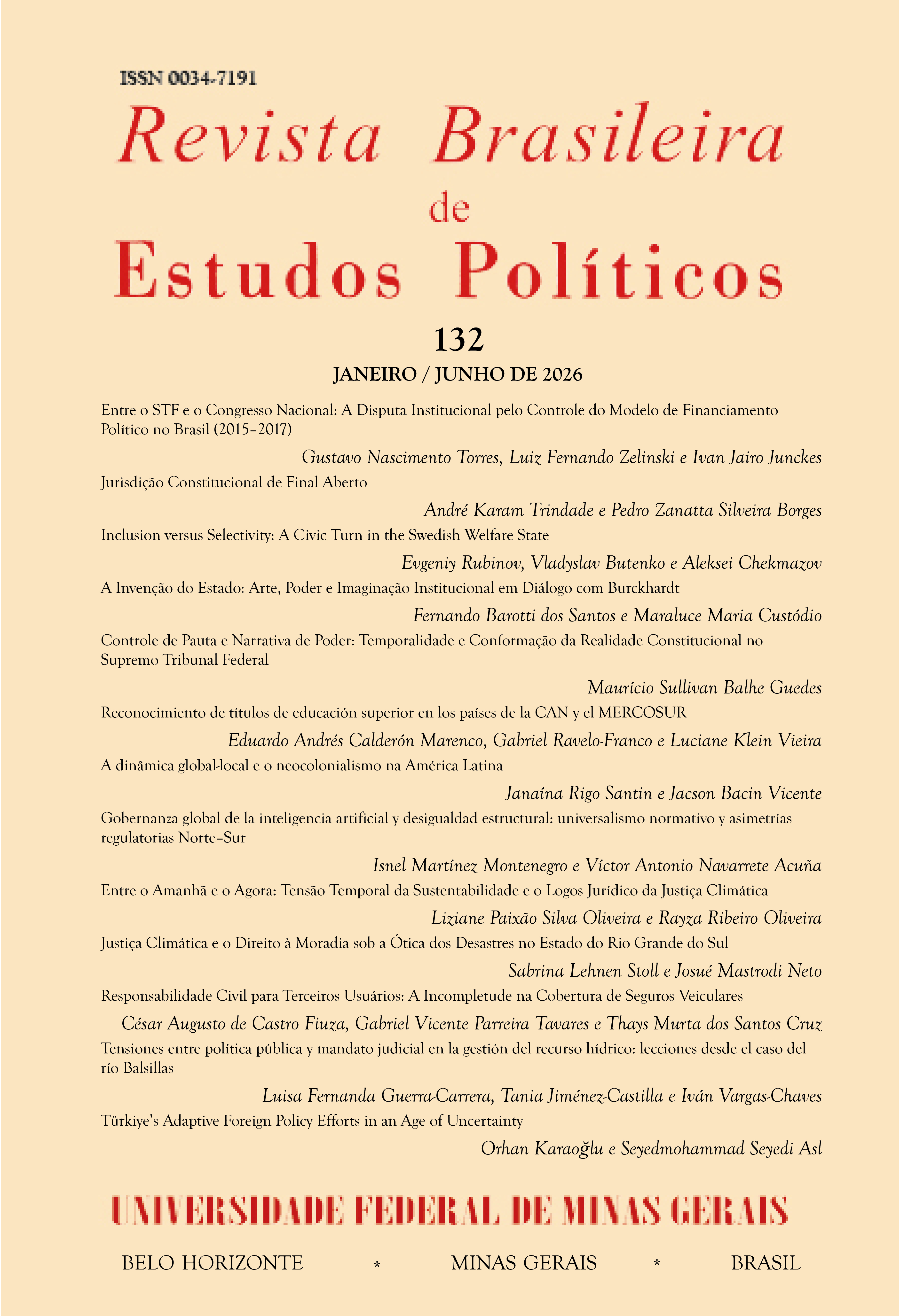
Inclusão versus Seletividade
Uma Virada Cívica no Estado de Bem-Estar Social Sueco
DOI:
https://doi.org/10.9732/Palavras-chave:
welfare state, migration policy, immigrant integration policy, welfare chauvinism, civic turnResumo
Este artigo analisa a transformação do Estado de bem-estar social sueco em um contexto de migração intensificada, com foco na mudança gradual do universalismo para a seletividade nas políticas de migração e integração de imigrantes. Com base nos conceitos de chauvinismo do bem-estar social e da “virada cívica”, os autores argumentam que as mudanças contemporâneas na Suécia não devem ser entendidas como um simples declínio do Estado de bem-estar social ou como a institucionalização da exclusão xenófoba. Em vez disso, representam uma reconfiguração normativa na qual os direitos sociais estão cada vez mais atrelados à condicionalidade, ao merecimento e à integração comprovada. O artigo demonstra que o universalismo sueco nunca foi totalmente incondicional, visto que elementos de disciplina e diferenciação estão presentes no modelo desde a sua formação. As crises das décadas de 1970 e 1980 e os desafios migratórios da década de 2010 reativaram essas tensões. Empiricamente, o estudo examina políticas de integração como planos individuais de introdução, obrigações educacionais, exigências linguísticas e condições mais rigorosas para residência e cidadania. Esses instrumentos ilustram como os benefícios sociais funcionam menos como direitos incondicionais e mais como ferramentas para promover uma integração “adequada”. Os autores concluem que a Suécia está passando por uma transição do universalismo baseado na igualdade de acesso para o universalismo baseado na igualdade de requisitos, redefinindo a solidariedade como pertencimento condicional em vez de inclusão incondicional.
Referências
ABTS, Koen; MULLE, Emmanuel Dalle; VAN KESSEL, Stijn; MICHEL, Elie. The welfare agenda of the populist radical right in Western Europe: Combining welfare chauvinism, producerism and populism. Swiss Political Science Review, v. 27, n. 1, pp. 21-40, 2021.
ADOLFSSON, Caroline. ‘I’m not Swedish Swedish’: Self-appraised national and ethnic identification among migrant-descendants in Sweden. Genealogy, v. 5, n. 2, 2021.
AFTONBLADET. Nya kravet: Max tre år för att lära sig svenska, 2 March 2024. Available at: https://www.aftonbladet.se/nyheter/a/8JrGoE/nya-kravet-max-tre-ar-for-att-lara-sig-svenska. Accessed on: 10/01/2026.
ALTHUSSER, Louis. Ideology and ideological state apparatuses (Notes towards an investigation). In: ALTHUSSER, Louis (ed). Lenin and philosophy and other essays. Delhi, Aakar Books, pp. 85-126, 2006.
ANDERSEN, Jørgen Goul; BJØRKLUND, Tor. Structural changes and new cleavages: The Progress Parties in Denmark and Norway. Acta Sociologica, v. 33, n. 3, pp. 195-217, 1990.
ARBETSFÖRMEDLINGEN. Arbetsmarknadsrapport 2017. Available at: https://mb.cision.com/Public/1326/2363232/a48fdfeab21e23bb.pdf. Accessed on: 10/01/2026.
ARBETSFÖRMEDLINGEN. Snabbspår, 2025. Available at: https://arbetsformedlingen.se/other-languages/english-engelska/stod-och-ersattning/stod-a-o/snabbspar. Accessed on: 11/01/2026.
BERGGREN, Henrik; TRÄGÅRDH, Lars. The Swedish theory of love: Individualism and trust in modern Sweden. Seattle: University of Washington Press, 2022.
BERGH, Andreas. What are the policy lessons from Sweden? On the rise, fall and revival of a capitalist welfare state. New Political Economy, v. 19, n. 5, pp. 662-694, 2014.
BEVELANDER, Pieter; BIVAND ERDAL, Marta; BROCHMANN, Grete; COCHRAN BECH, Emily; HAGENSEN MIDTBØEN, Arnfinn; MOURITSEN, Per. Infödda och invandrare ense om krav för medborgarskap. Dagens Nyheter, 3 December 2019. Available at: https://www.dn.se/debatt/infodda-och-invandrade-ense-om-krav-for-medborgarskap. Accessed on: 11/01/2026.
BLOMQVIST, Paula; PALME, Joakim. Universalism in welfare policy: The Swedish case beyond 1990. Social Inclusion, v. 8, n. 1, pp. 114-123, 2020.
BRYANT, Miranda. Top EU court adviser finds Denmark’s ‘ghetto law’ is direct discrimination. Guardian, 13 February 2025. Available at: https://www.theguardian.com/world/2025/feb/13/top-eu-court-adviser-denmark-ghetto-law-parallel-society-act-direct-discrimination. Accessed on: 11/01/2026.
BUTENKO, Vladyslav; CHEKMAZOV, Aleksei. Transformation of social democrats’ ideological views in Denmark and Sweden: Migration case. Nauchno-analiticheskij vestnik IE RAN, v. 46, n. 4, pp. 54-63, 2025.
CAREJA, Romana; ELMELUND‐PRÆSTEKÆR, Christian; KLITGAARD, Michael Baggesen; LARSEN, Erik Gahner. Direct and indirect welfare chauvinism as party strategies: An analysis of the Danish People’s Party. Scandinavian Political Studies, v. 39, n. 4, pp. 435-457, 2016.
CAREJA, Romana; HARRIS, Eloisa. Thirty years of welfare chauvinism research: Findings and challenges. Journal of European Social Policy, v. 32, n. 2, pp. 212-224, 2022.
DAHLSTEN, Nina; LINDSTRÖM, Peter; EKBERG, Sofie. Proposal for stricter income requirements for Swedish citizenship. KPMG, 24 March 2025. Available at: https://kpmg.com/se/en/insights/newsletters/taxnews/2025/proposal-for-stricter-income-requirements-for-Swedish-citizenship.html. Accessed on: 11/01/2026.
DOWNIE Jr., Leonard. More Swedes find welfare state too taxing. Washington Post, 1 September 1979. Available at: https://www.washingtonpost.com/archive/politics/1979/09/02/more-swedes-find-welfare-state-too-taxing/edcef3d2-8792-4b50-ba0c-96a0a4b805c5. Accessed on: 11/01/2026.
ECRI. ECRI Report on Sweden (Fifth Monitoring Cycle), 2018. Available at: https://rm.coe.int/fifth-report-on-sweden/16808b5c58. Accessed on: 11/01/2026.
EICK, Giana Maria; LERUTH, Benjamin. A farewell to welfare? Conceptualising welfare populism, welfare chauvinism and welfare Euroscepticism. Journal of European Social Policy, v. 34, n. 2, pp. 117-127, 2024.
ELGENIUS, Gabriella; RYDGREN, Jens. Who are the “People” and what does “Home” mean? A case of frame transformation and counter-framing of the “People’s Home” in the Sweden Democrat Rhetoric 1989–2022. Social Semiotics, pp. 1-14, 2025.
ESPING-ANDERSEN, Gøsta. The Three Worlds of Welfare Capitalism. Cambridge: Polity Press, 1990.
FORD, Robert; SOBOLEWSKA, Maria; KOOTSTRA, Anouk. What drives welfare chauvinism in Europe? West European Politics, v. 49, n. 2, pp. 321-349, 2026.
GOODMAN, Sara Wallace. The civic integration turn. In: BONJOUR, Saskia; WEINAR, Agnieszka; ZHYZNOMIRSKA, Lyubov (eds). The Routledge handbook of the politics of migration in Europe. London: Routledge, pp. 167-178, 2018.
GREVE, Bent. Why inequality matters. In: GREVE, Bent (ed). Welfare, populism and welfare chauvinism. Bristol: Bristol University Press, pp. 39-56, 2019.
HARRIS, Eloisa; RÖMER, Friederike. Contextual welfare chauvinism: Left‐wing governments and immigrant welfare rights in Western Europe. European Journal of Political Research, v. 62, n. 2, 443–462, 2023.
HIRDMAN, Yvonne. Att lägga livet till rätta – Studier i svensk folkhemspolitik. Stockholm: Carlsson Bokförlag, 2010.
HJORTH, Frederik. Who benefits? Welfare chauvinism and national stereotypes. European Union Politics, v. 17, n. 1, pp. 3-24, 2016.
JOPPKE, Christian. Civic integration in Western Europe: Three debates. West European Politics, v. 40, n. 6, pp. 1153-1176, 2017.
KESKINEN, Suvi; NOROCEL, Ov Cristian; JØRGENSEN, Martin Bak. The politics and policies of welfare chauvinism under the economic crisis. Critical Social Policy, v. 36, n. 3, pp. 321-329, 2016.
KITSCHELT, Herbert; McGANN, Anthony J. The radical right in Western Europe: A comparative analysis. Ann Arbor: University of Michigan Press, 1997.
KROS, Mathijs; COENDERS, Marcel. Explaining differences in welfare chauvinism between and within individuals over time: The role of subjective and objective economic risk, economic egalitarianism, and ethnic threat. European Sociological Review, v. 35, n. 6, pp. 860-873, 2019.
LERUTH, Benjamin; TAYLOR-GOOBY, Peter; GYŐRY, Adrienn. Categorizing discourses of welfare chauvinism: Temporal, selective, functional and cultural dimensions. Journal of European Social Policy, v. 34, n. 2, pp. 128-141, 2024.
LUBBERS, Marcel; SEIBEL, Verena. Welfare chauvinism: Are immigrants granted access to welfare state benefits? In: YERKES, Mara A.; BAL, Michèlle (eds). Solidarity and social justice in contemporary societies: An interdisciplinary approach to understanding inequalities. Cham: Palgrave Macmillan, pp. 147-155, 2022.
MIGRATIONSVERKET. Granted residence permits overviews, 2023. Available at: https://www.migrationsverket.se/English/About-the-Migration-Agency/Statistics/Granted-permits-overviews.html. Accessed on: 11/01/2026.
MIGRATIONSVERKET. Asyl, 2025. Available at: https://www.migrationsverket.se/OmMigrationsverket/Statistik/Asyl.html. Accessed on: 11/01/2026.
MILANI, Tommaso; BAUER, Simon; CARLSON, Marie; SPEHAR, Andrea; VON BRÖMSSEN, Kerstin. Citizenship as status, habitus and acts: Language requirements and civic orientation in Sweden. Citizenship Studies, v. 25, n. 6, pp. 756-772, 2021.
MINISTRY OF JUSTICE. Integration requirements, 2023. Available at: https://www.government.se/government-policy/swedens-new-migration-policy/stalla-krav-pa-integration. Accessed on: 10/01/2026.
MINISTRY OF JUSTICE. Inquiry proposes more stringent Swedish citizenship requirements, 2025. Available at: https://www.government.se/press-releases/2025/01/inquiry-proposes-more-stringent-swedish-citizenship-requirements. Accessed on: 11/01/2026.
NORDENS VÄLFÄRDSCENTER. Nordregio working paper 2017:8. Policies and measures for speeding up labour market integration of refugees in the Nordic region: A knowledge overview. Available at: https://nordicwelfare.org/wp-content/uploads/2018/03/FULLTEXT022.pdf. Accessed on: 11/01/2026.
ÖBRINK HOBZOVÁ, Milena. Development and current challenges of language courses for immigrants in Sweden. Journal of Adult and Continuing Education, v. 27, n. 1, pp. 84-99, 2021.
REGERINGSKANSLIET. Prop. 2015/16:174. Tillfälliga begränsningar av möjligheten att få uppehållstillstånd i Sverige. Available at: https://www.regeringen.se/contentassets/075968fdd8c94788977dba14bae16444/forslag-om-att-tillfalligt-begransa-mojligheten-att-fa-uppehallstillstand-i-sverige-prop.-201516174. Accessed on: 11/01/2026.
REGERINGSKANSLIET. Prop. 2016/17:175. Ett nytt regelverk för nyanlända invandrares etablering i arbets- och samhällslivet. Available at: https://www.regeringen.se/4965e5/contentassets/4eccccf8c5d74e0c8b5110289265d866/ett-nytt-regelverk-for-nyanlanda-invandrares-etablering-i-arbets--och-samhallslivet-prop.-201617175. Accessed on: 11/01/2026.
REINIKAINEN, Jouni. The view of freedom that shaped the Swedish welfare state. Scandinavian Political Studies, v. 47, n. 3, pp. 493-513, 2024.
ROTHSTEIN, Bo. Just institutions matter: The moral and political logic of the universal welfare state. New York: Cambridge University Press, 1998.
STATISTISKA CENTRALBYRÅN. Population in Sweden by country/region of birth, citizenship and Swedish/foreign background, 2022. Available at: https://www.scb.se/en/finding-statistics/statistics-by-subject-area/population/population-composition/population-statistics/pong/tables-and-graphs/foreign-born-citizenship-and-foreignswedish-background/population-in-sweden-by-countryregion-of-birth-citizenship-and-swedishforeign-background-31-december-2022. Accessed on: 10/01/2026.
VADLAMANNATI, Krishna Chaitanya. Welfare chauvinism? Refugee flows and electoral support for populist‐right parties in industrial democracies. Social Science Quarterly, v. 101, n. 4, pp. 1600-1626, 2020.
WESTIN, Charles; DINGU-KYRKLUND, Elena. Immigration and integration of immigrants and their descendants: The Swedish approach. In: HECKMANN, Friedrich; SCHNAPPER, Dominique (eds). The integration of immigrants in European societies: National differences and trends of Convergence. Berlin: Walter de Gruyter GmbH, pp. 105-134, 2003.
WIGGEN, Mette. The normalisation of welfare chauvinism. IPPR Progressive Review, v. 29, n. 2, pp. 101-108, 2022.
Downloads
Publicado
Edição
Seção
Licença
Autores que publicam nesta revista concordam com os seguintes termos:
Os autores mantêm os direitos autorais e concedem à Revista Brasileira de Estudos Políticos o direito de primeira publicação, com o trabalho simultaneamente licenciado sob a Licença Creative Commons Attribution. Essa licença permite o compartilhamento do trabalho com reconhecimento da autoria e publicação inicial nesta revista, desde que sem fins comerciais.
É permitido ainda que outros distribuam, adaptem e criem a partir do seu trabalho, sem fins comerciais, desde que lhe atribuam o devido crédito pela criação original.
Autores têm autorização para assumir contratos adicionais separadamente, para distribuição não-exclusiva da versão do trabalho publicada nesta revista (ex.: publicar em repositório institucional ou como capítulo de livro), com reconhecimento de autoria e publicação inicial nesta revista.
Autores têm permissão e são estimulados a publicar e distribuir seu trabalho online após o processo editorial, já que isso pode gerar alterações produtivas, bem como aumentar o impacto e a citação do trabalho publicado.
Authors who publish in this journal agree to the following terms:
The authors maintain the copyright and grant the Brazilian Journal of Political Studies the right of first publication, with the work simultaneously licensed under the Creative Commons Attribution License. This license allows the sharing of the work with authorship recognition and initial publication in this journal, as long as it is not for commercial purposes.
It is also allowed that others distribute, adapt and create from their work, without commercial purposes, as long as they attribute due credit for the original creation.
Authors are allowed to enter into additional contracts separately for non-exclusive distribution of the version of the work published in this journal (e.g., publish in an institutional repository or as a book chapter), with authorship recognition and initial publication in this journal.
Authors are allowed and encouraged to publish and distribute their work online after the editorial process, as this can generate productive changes as well as increase the impact and citation of the published work.