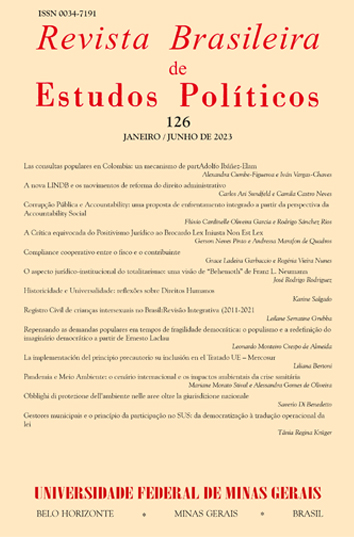
Compliance cooperativo entre o fisco e o contribuinte
DOI:
https://doi.org/10.9732/2023.V126.865Keywords:
Tax Administration; Cooperation; ComplianceAbstract
This article analyzes the cooperative compliance system between tax authorities and taxpayers and its influence on the maintenance of civil rights. The current model of inspection is inefficient and ineffective. Thus, it addresses the implementation of a new system that brings tax administration and taxpayers closer together to encourage voluntary compliance and compliance with tax rules, demonstrating the importance of using a Tax Cooperation System in the Tax Administration. The methodology used was bibliographic research, especially the studies proposed by Andrade (2017), Maeda (2013), Giovanini (2014) and Leal (2016). The results demonstrated the importance of a differentiated action by the tax administration, which should help the taxpayer, sharing information and answering doubts and questions, prioritizing dialogue and preventive conflict resolution. Thus, it is clear the importance of proximity between the taxpayer and the tax authorities, through a relationship of trust. It was concluded, that the implementation of a cooperative tax regulation model would reduce insecurity, in view of the gain in certainty and clarity, through a coordinated service, together with the tax administration, and would allow the growth of voluntary compliance. tax obligations.
References
ANDRADE, F. C. M. de; FERREIRA, I. C. Compliance Trabalhista: Compreendendo a Prevenção de Risco Trabalhista por Meio do Programa de Integridade. São Paulo: Revista Síntese Trabalhista e Previdenciária, jan. 2017.
AYRES, Carlos Henrique da Silva. Programas de Compliance no âmbito da Lei n. 12.846/2013: importância e principais elementos. São Paulo: Revista do Advogado, ano XXXIV, n. 125, dez. de 2014.
BARBOSA, Michelle Santos. Compliance Ambiental. São Paulo: Revista Jurídica LEX, mai-jun. 2013.
BRASIL. Decreto Nº 8.420, de 18 de março de 2015. Disponível em: http://www.planalto.gov.br/ccivil_03/_ato2015-2018/2015/decreto/d8420.htm. Acesso em 0/07/2020.
GIOVANINI, Wagner. Compliance: a Excelência na Prática. Rio Grande do Sul: Ed. Compliance Total, 2014
LEAL, Juliana Dato. Compliance Trabalhista e a Lei 12.846/13. Jus Brasil. Disponível em https://julianadato.jusbrasil.com.br/artigos/207136251/Compliance-trabalhista-e-a-lei-12846-13. Acesso em 30/07/2020.
MAEDA, Bruno Carneiro. Programas de Compliance Anticorrupção: importância e elementos essenciais. In: Temas de Anticorrupção e Compliance. Rio de Janeiro: Elsevier, 2013
MATIAS PEREIRA, José. Curso de Administração Pública: Foco nas instituições e ações governamentais. 3. ed. São Paulo, SP: Editora Atlas, 2010.
NETO, Fernando Augusto Vale de Alencar. A implementação do Compliance nas empresas estatais. Salvador-BA: Monografia (Graduação em Direito), Orientador Geovane de Mori Peixoto, Faculdade Baiana de Direito, 2017.
PEIXOTO, Geovane de Mori. A Adoção de Sistema de Compliance e o Novo Marco Legal de Combate à Corrupção. São Paulo: Revista Síntese Direito Empresarial, mar-abr. 2015.
ROSENBERG, Hillary; KAUFMANN, Adam; PLOCHOKI, Tara. The U.S. Foreign Corrupt Practices Act: eradicating corruption in U.S and non U.S. companies. SÃO PAULO: Revista dos Tribunais, v. 947, ano 103, set. 2014.
SOUSA, Kélika Christina de Oliveira; FEEREIRA NETO. A Importância da Governança Corporativa para Gestão Pública Municipal. Disponível em: http://www.cpgls.pucgoias.edu.br/8mostra/Artigos/sociais%20aplicadas/a%20import%c3%82ncia%20da%20governan%c3%87a%20corporativa%20para%20 gest%c3%83o%20-%20kelica%20e%20m%c3%81rio.pdf. Acesso em: 01/08/2020.
VENTRY JR., Dennis. Cooperative tax regulation. Connecticut Law Review, v. 41, n. 2, dez. 2008.
VITALIS, Aline. Compliance fiscal e regulação fiscal cooperativa. Disponível em: https://www.scielo.br/scielo.php?script=sci_arttext&pid=S1808-24322019000100202#aff1. Acesso em 01/08/2020.
Downloads
Published
Issue
Section
License
Autores que publicam nesta revista concordam com os seguintes termos:
Os autores mantêm os direitos autorais e concedem à Revista Brasileira de Estudos Políticos o direito de primeira publicação, com o trabalho simultaneamente licenciado sob a Licença Creative Commons Attribution. Essa licença permite o compartilhamento do trabalho com reconhecimento da autoria e publicação inicial nesta revista, desde que sem fins comerciais.
É permitido ainda que outros distribuam, adaptem e criem a partir do seu trabalho, sem fins comerciais, desde que lhe atribuam o devido crédito pela criação original.
Autores têm autorização para assumir contratos adicionais separadamente, para distribuição não-exclusiva da versão do trabalho publicada nesta revista (ex.: publicar em repositório institucional ou como capítulo de livro), com reconhecimento de autoria e publicação inicial nesta revista.
Autores têm permissão e são estimulados a publicar e distribuir seu trabalho online após o processo editorial, já que isso pode gerar alterações produtivas, bem como aumentar o impacto e a citação do trabalho publicado.
Authors who publish in this journal agree to the following terms:
The authors maintain the copyright and grant the Brazilian Journal of Political Studies the right of first publication, with the work simultaneously licensed under the Creative Commons Attribution License. This license allows the sharing of the work with authorship recognition and initial publication in this journal, as long as it is not for commercial purposes.
It is also allowed that others distribute, adapt and create from their work, without commercial purposes, as long as they attribute due credit for the original creation.
Authors are allowed to enter into additional contracts separately for non-exclusive distribution of the version of the work published in this journal (e.g., publish in an institutional repository or as a book chapter), with authorship recognition and initial publication in this journal.
Authors are allowed and encouraged to publish and distribute their work online after the editorial process, as this can generate productive changes as well as increase the impact and citation of the published work.