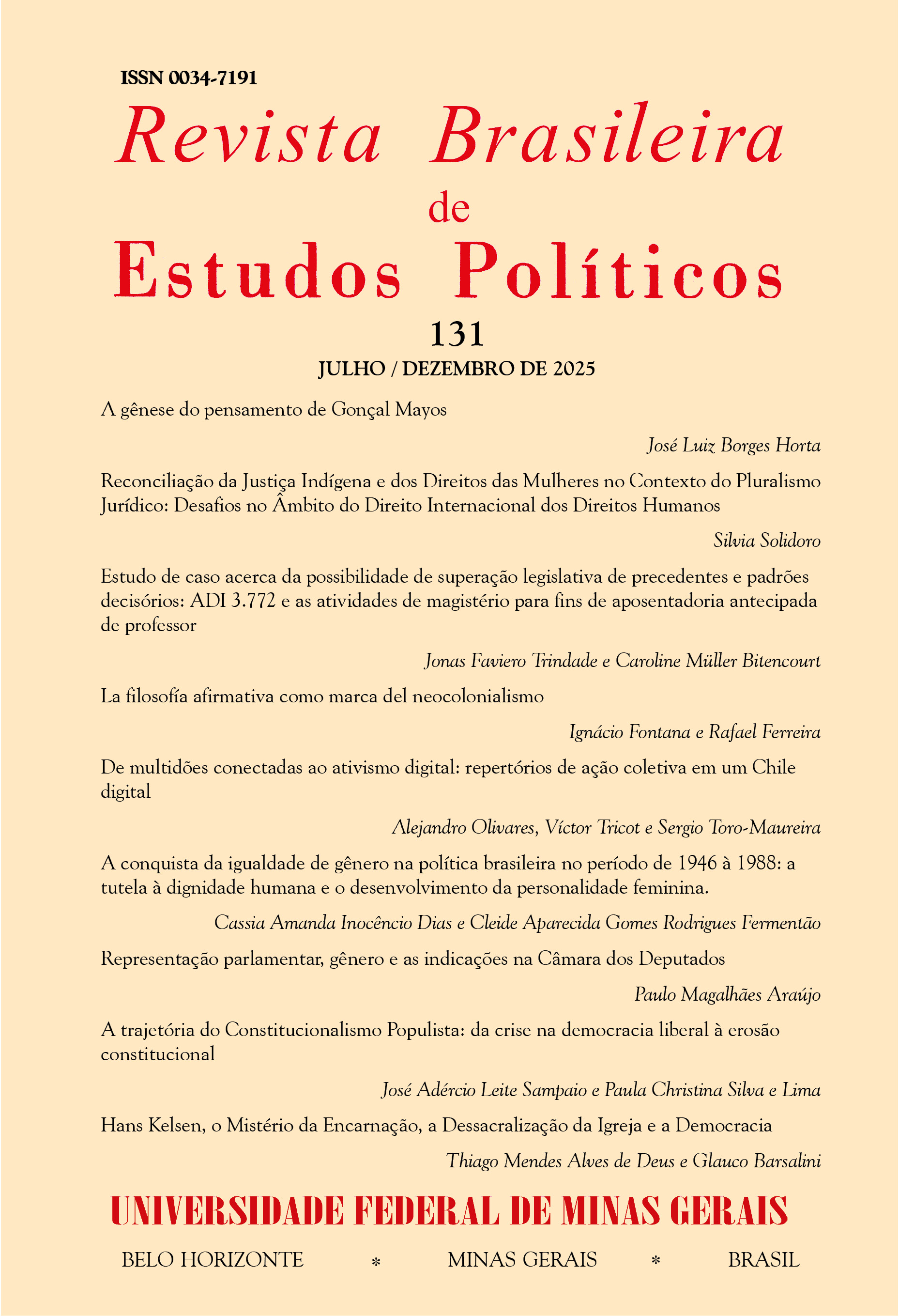
Representação parlamentar, gênero e as indicações na Câmara dos Deputados
DOI:
https://doi.org/10.9732/2025.V131.1411Abstract
Does gender representation make a difference in the legislative production of federal deputies? That is the question. Based on legislative nominations presented between 2003 and 2022 in the Chamber of Deputies, this article compares female and male federal deputies with a view to capturing and understanding possible differences between genders regarding the content of what they produce in parliament. To this end, the 34,199 nominations from the period were categorized by general themes – such as health, education and economy – and by specific themes of the female political agenda – such as reproductive rights, gender equality and motherhood. The analysis of empirical data was based on key concepts such as descriptive representation, substantive representation and critical mass, mobilized by theoretical and empirical researchers in studies on the representation of women and other political minorities. It was observed, in accordance with the literature, that the performance of representatives is complex, such that men and women overcome gender barriers and act in the field of the opposite sex. It was noted, however – also in accordance with the literature – that female federal deputies are more likely than their male counterparts to defend issues on the so-called female political agenda. Nuances of the production analyzed are discussed throughout the article.
References
ALLEN, Carmen R., Women Representing Women's Interests in Congress. Masters Theses. Illinois: Eastern Illinois University, 2004.
ARAÚJO, Paulo Magalhães. Representação em preto e branco: raça-cor e a produção de indicações na câmara dos deputados. InterSciencePlace, v. 19. pp. 620-649, 2024.
BROADBENT, Luxia. Female Representation and the Substantive Representation of Women’s Interests by Male MPs. 2019. Dissertation (MSc Public Administration and Government) London School of Economics and Political Science, London. 2019.
BENTHAM, Jeremy. Introdução aos princípios da moral e da legislação. São Paulo: Abril Cultural, 1974.
CAMPOS, Luiz Augusto; MACHADO, Carlos. Raça e eleições no Brasil. Porto Alegre: Editora Zouk, 2020.
CAUL, M. Women’s Representation in Parliament: The Role of Political Parties. Party Politics, London, v. 5, n. 1, pp. 79–98, 1999.
CELIS, Karen. Substantive Representation of Women (and improving it). What is and should it be about? Annual meeting of the American Political Science Associaton, Boston, 2008.
CELIS, Karen; CHILDS, Sarah, Rightist Parties and Women’s Substantive Representation, aug. 8, 2011. Disponível em: http://dx.doi.org/10.2139/ssrn.1906612; Acesso em 13, nov., 2024.
CHILDS, Sarah; KROOK, Mona Lena. Critical Mass Theory and Women’s Political Representation. Political Studies, London, v. 56, pp. 725–736, 2008.
CHILDS, Sarah; KROOK, Mona Lena. Should feminists give up on critical mass? A contingent “Yes”, Politics and Gender, Cambridge, v. 2, n. 4, pp. 522-530, 2006.
CELIS, Karen; CHILDS, Sarah; KANTOLA, Johanna; KROOK, Mona Lena (2008). Rethinking women's substantive representation, Representation, London, v. 44, n. 2, pp. 99-110.
CHANEY. Paul. Critical Mass, deliberation and the substantive representation of women: evidence from the UK’s devolution programme. Political Studies, London, v. 54, pp. 691–714, 2006.
DAHLERUP, Drude. 1988. From a small to a large minority: women in Scandinavian politics. Scandinavian Political Studies, Stockholm, v. 11, n. 4, pp. 275-297.
D’ÁVILA FILHO, Paulo M.; LIMA, Paulo C. G. de Cerqueira; JORGE, Vladimyr Lombardo. Produção legislativa e intermediação de interesses: uma análise das Indicações na Câmara Municipal do Rio de Janeiro. Anais do 35º Encontro Anual da Anpocs, Caxambu, 2011.
FENNO, Richard. U.S. House Members in Their Constituencies: An Exploration. American Political Science Review, Washington DC, v. 71, n. 1, pp. 883-917, 1977.
FRANCO, G. C. Comportamento legislativo das deputadas federais brasileiras: Uma análise da produção legislativa de 1987 a 2007. Revista Eletrônica de Ciência Política, Curitiba, v. 11, n. 1, pp. 56-78, 2020.
GARBONI, Emanuela Simona. The impact of descriptive representation on substantive representation of women at European and national parliamentary levels. Case Study: Romania. Procedia - Social and Behavioral Sciences, Amsterdam, n. 183, pp. 85-92, 2015.
HOHMANN, Daniel. When Do Men Represent Women’s Interests in Parliament? How the Presence of Women in Parliament Affects the Legislative Behavior of Male Politicians. Swiss Political Science Review, Hoboken, v. 26, n. 1, pp. 31–50, 2020.
HTUN, Mala N. Women, Political parties and electoral systems in Latin America. In: BALLINGTON, Julie; KARAM, Azza (eds.). Women in parliament: beyond numbers. Stockholm: International IDEA, 2005, pp. 112-121.
KANTER, Rosabeth M. Some effects of proportions on group life: skewed sex ratios and responses to token women. American Journal of Sociology, Chicago, v. 82, n. 5, pp. 965-990, 1977.
LIMÃO DA SILVA, Ana Paula Cavalcante. A representação substantiva feminina na câmara legislativa brasileira, no período de 2003 a 2015. Teoria & Pesquisa: Revista de Ciência Política, São Carlos, v. 32, n. esp. 1, pp. 1–23, 2023.
MACKAY, Fiona. Gender and Political Representation in the UK: The State of the ‘Discipline’. British Journal of Politics and International Relations (BJPIR), Oxford, v. 6, pp. 99-120, 2004.
MANSBRIDGE, Jane. Should blacks represent blacks and women represent women? A contingent “Yes”. The Journal of Politics, Chicago, v. 61, n. 3, pp. 628-657, 1999.
MAYHEW, David R. Congress: the electoral connection. New Haven: Yale University Press, 1974.
MIGUEL, Luis Felipe; FEITOSA, Fernanda. O Gênero do Discurso Parlamentar: Mulheres e Homens na Tribuna da Câmara dos Deputados. DADOS – Revista de Ciências Sociais, Rio de Janeiro, v. 52, no 1, pp. 201-221, 2009.
MILL, James. The Political Writings of James Mill: Essays and Reviews on Politics and Society, 1815-1836. Indianapolis: Liberty Fund, 2013.
MILL, John Stuart. Considerações sobre o governo representativo. Brasília, Editora Universidade de Brasília, 1981.
PARK, Soon Seok. Gendered representation and critical mass: women’s legislative representation and social spending in 22 OECD countries. Sociological Perspective, Berkeley, v. 60, n. 6, pp. 1097-1114, 2017.
PHILLIPS, Anne. The politics of presence. Oxford New York: Clarendon Press Oxford University Press, 1995.
PHILLIPS, Anne. Representing difference: why it matters if women get elected. In: COOTE, Anna (ed), New Gender Agenda. London: IPPR, pp. 58-66, 2000.
PHILLIPS, Anne. De uma política de idéia de uma política de idéias a uma política de presença? Estudos Feministas, Ano 9, 2001, pp. 268-290.
PITKIN, Hanna Fenichel. The Concept of Representation. Berkeley: University of California Press, 1967.
REZENDE, Daniela. Desafios à representação política de mulheres na Câmara dos Deputados. Estudos Feministas, Florianópolis, v. 25, n. 3, pp. 1199-1218, 2017
SCHEIDWEILER, Gerson; OLIVEIRA, Ana Cláudia Sousa, SOUSA, Janara Kalline Leal Lopes. Mulheres parlamentares e representação substantiva no Brasil. Estudos Feministas, Florianópolis, v. 31, n. 1, 2022, pp. 01-15.
STUART MILL, John. Sobre o Governo Representativo. Brasília: UnB, 1981.
TAYLOR-ROBINSON, Michelle M.; HEATH, Roseanna Michelle. Do Women Legislators Have Different Policy Priorities than Their Male Colleagues?, Women & Politics, London, v. 24, n. 4, pp. 77-101.
WANGNERUD, Lena. Women in Parliaments: Descriptive and Substantive Representation. Annu. Rev. Polit. Sci., San Mateo, n. 12, pp. 51–69, 2009.
Downloads
Published
Issue
Section
License
Autores que publicam nesta revista concordam com os seguintes termos:
Os autores mantêm os direitos autorais e concedem à Revista Brasileira de Estudos Políticos o direito de primeira publicação, com o trabalho simultaneamente licenciado sob a Licença Creative Commons Attribution. Essa licença permite o compartilhamento do trabalho com reconhecimento da autoria e publicação inicial nesta revista, desde que sem fins comerciais.
É permitido ainda que outros distribuam, adaptem e criem a partir do seu trabalho, sem fins comerciais, desde que lhe atribuam o devido crédito pela criação original.
Autores têm autorização para assumir contratos adicionais separadamente, para distribuição não-exclusiva da versão do trabalho publicada nesta revista (ex.: publicar em repositório institucional ou como capítulo de livro), com reconhecimento de autoria e publicação inicial nesta revista.
Autores têm permissão e são estimulados a publicar e distribuir seu trabalho online após o processo editorial, já que isso pode gerar alterações produtivas, bem como aumentar o impacto e a citação do trabalho publicado.
Authors who publish in this journal agree to the following terms:
The authors maintain the copyright and grant the Brazilian Journal of Political Studies the right of first publication, with the work simultaneously licensed under the Creative Commons Attribution License. This license allows the sharing of the work with authorship recognition and initial publication in this journal, as long as it is not for commercial purposes.
It is also allowed that others distribute, adapt and create from their work, without commercial purposes, as long as they attribute due credit for the original creation.
Authors are allowed to enter into additional contracts separately for non-exclusive distribution of the version of the work published in this journal (e.g., publish in an institutional repository or as a book chapter), with authorship recognition and initial publication in this journal.
Authors are allowed and encouraged to publish and distribute their work online after the editorial process, as this can generate productive changes as well as increase the impact and citation of the published work.