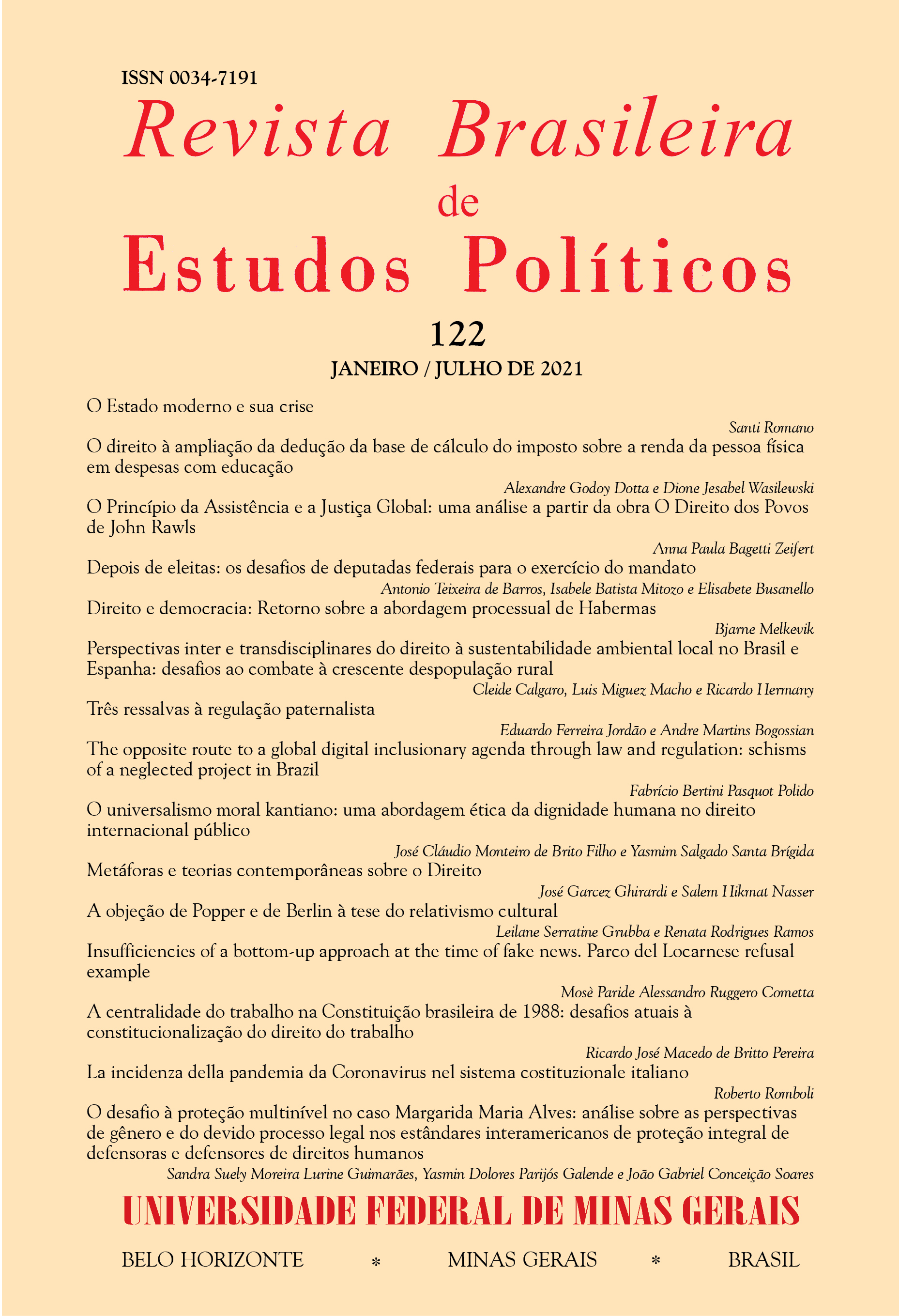
The Principle of Assistance and Global Justice
an analysis from the John Rawls’ work Law of Peoples
DOI:
https://doi.org/10.9732/2021.v122.673Abstract
PROBLEMATIC: The problematic of this article comprises the analysis of the Rawlsian proposal of justice for a Society of Peoples and the author's concern in ensuring stability and the minimum of social justice within societies, considering that the work The Law of Peoples has its scope limited to the political sphere, supported by elements that make up the Rawlsian social ideal, presupposed initially in A Theory of Justice.
OBJECTIVES: To analyze the Principle of Assistance for the Law of Peoples as an element of the project of justice that pervades the author's entire work and that gains specific contours in A Society of Peoples. To demonstrate that the Duty of Assistance among Peoples is part of the Rawlsian social ideal thought in his three main texts, that is, the search for a complete conception of justice that requires a basic structure and just social institutions, principles of social justice and the purpose of cooperation.
METHODOLOGY: The research uses the hypothetical-deductive approach, centered on bibliographic research of works of political philosophy, with specific study of the theory of justice articulated by John Rawls, as well as the elements present in the Rawlsian project of justice for national societies and resumed in the proposal of social justice among peoples.
RESULT: The Duty of Assistance, as a new element introduced in the latest version of The Law of Peoples, demonstrates, once again, Rawls' commitment to the stability of institutions, to political justice in societies, which, if not liberal, are at least decent, and, finally, to the guarantee of freedom and equality for all societies. This highlights the two main ideas of The Law of Peoples exposed in the opening of the work: 1) the great evils of humanity arise from political injustice; and 2) the elimination of these evils only occurs through just or decent social policies and equally just or decent social institutions, which would guarantee stability and justice for the Society of Peoples.
CONCLUSIONS: We conclude that both the principle requiring the observance of human rights and the principle of Assistance have political goals and are intertwined in the proposal of political justice thought for the Peoples' Society. The first, with the intention of promoting peace and stability, avoids choosing rights of essentially liberal content and discussions with specific conceptions of good; the second having as objective the legitimacy of societies from a basic structure and fair institutions and the idea of cooperation, aims at a dignified life founded on freedom and equality, part of the Rawlsian social ideal.
References
AUDARD, C. Cidadania e democracia deliberativa. Tradução de Walteer Valdevino. Porto Alegre: EDIPUCRS.
BEITZ, C. R. Liberalismo internacional e justiça distributiva. In: Lua Nova, n. 47, 1999.
BOBBIO, N. Teoria geral da política: a filosofia política e a lição dos clássicos. Michelangelo Bovero (Org.). Tradução de Daniela Beccaccia Versiani. Rio de Janeiro: Elsevier, 2000.
CABRITA, M. J. A justiça internacional em John Rawls: o dever de assistência na lei dos povos. In: Diacrítica, Série Filosofia/Cultura, Universidade do Minho, n. 19/2, 2005.
______. Justiça global: o influxo rawlsiano e a demarcação da lei dos povos. In: Diacrítica, 24 (2), Série Filosofia/Cultura, Universidade do Minho, CEH-UM: Húmus, 2010.
LOVETT, F. Uma teoria da justiça de John Rawls. Guia de leitura. Tradução de Vinícius Figueira. Porto Alegre: Penso, 2013.
PARIJS, P. V. O que é uma sociedade justa? Introdução à prática da filosofia política. Trad. e rev. de Cintia Ávila de Carvalho e Álvaro de Vita. São Paulo: Ática, 1997.
POGGE, T. W. Uma proposta de reforma: um dividendo global de recursos. In: Lua Nova, n. 34, 1994.
______. Para erradicar a pobreza sistêmica: em defesa de um dividendo dos recursos globais. Sur, Revista Internacional de Direitos Humanos, vol. 4, n. 6, 2007.
RAWLS, J. Justiça como equidade: uma concepção política, não metafísica. In: Lua Nova: Revista de Cultura e Política. n. 25. Tradução de Regis de Castro Andrade, 1992. p.. 25-59.
______. Uma teoria da justiça. Tradução de Almiro Pisetta e Lenita M. R. Esteves. São Paulo: Martins Fontes, 2002.
______. Justice as fairness: a restatement. Cambridge, Mass: Harvard University Press, 2001.
______ Justiça como equidade: uma reformulação. Tradução de Claudia Berliner; rev. técnica Álvaro De Vita. São Paulo: Martins Fontes, 2003.
______. The Law of Peoples; With the idea of Public Reason Revised. Second printing. Harvard University Press, 2000.
______. O Direito dos Povos. Tradução de Luís Carlos Borges. São Paulo: Martins Fontes, 2001.
SEN, A. A ideia de justiça. Tradução de Ricardo Doninelli Mendes e Denise Bottmann. São Paulo: Companhia das Letras, 2011.
______. KLIKSBERG, Bernardo. As pessoas em primeiro lugar: a ética do desenvolvimento e os problemas do mundo globalizado. Tradução de Bernardo Ajzemberg e Carlos Eduardo Lins da Silva. São Paulo: Companhia das Letras, 2010.
______. Desenvolvimento como liberdade. Tradução de Laura Teixeira Motta. São Paulo: Companhia das Letras, 2000.
Downloads
Published
Issue
Section
License
Autores que publicam nesta revista concordam com os seguintes termos:
Os autores mantêm os direitos autorais e concedem à Revista Brasileira de Estudos Políticos o direito de primeira publicação, com o trabalho simultaneamente licenciado sob a Licença Creative Commons Attribution. Essa licença permite o compartilhamento do trabalho com reconhecimento da autoria e publicação inicial nesta revista, desde que sem fins comerciais.
É permitido ainda que outros distribuam, adaptem e criem a partir do seu trabalho, sem fins comerciais, desde que lhe atribuam o devido crédito pela criação original.
Autores têm autorização para assumir contratos adicionais separadamente, para distribuição não-exclusiva da versão do trabalho publicada nesta revista (ex.: publicar em repositório institucional ou como capítulo de livro), com reconhecimento de autoria e publicação inicial nesta revista.
Autores têm permissão e são estimulados a publicar e distribuir seu trabalho online após o processo editorial, já que isso pode gerar alterações produtivas, bem como aumentar o impacto e a citação do trabalho publicado.
Authors who publish in this journal agree to the following terms:
The authors maintain the copyright and grant the Brazilian Journal of Political Studies the right of first publication, with the work simultaneously licensed under the Creative Commons Attribution License. This license allows the sharing of the work with authorship recognition and initial publication in this journal, as long as it is not for commercial purposes.
It is also allowed that others distribute, adapt and create from their work, without commercial purposes, as long as they attribute due credit for the original creation.
Authors are allowed to enter into additional contracts separately for non-exclusive distribution of the version of the work published in this journal (e.g., publish in an institutional repository or as a book chapter), with authorship recognition and initial publication in this journal.
Authors are allowed and encouraged to publish and distribute their work online after the editorial process, as this can generate productive changes as well as increase the impact and citation of the published work.