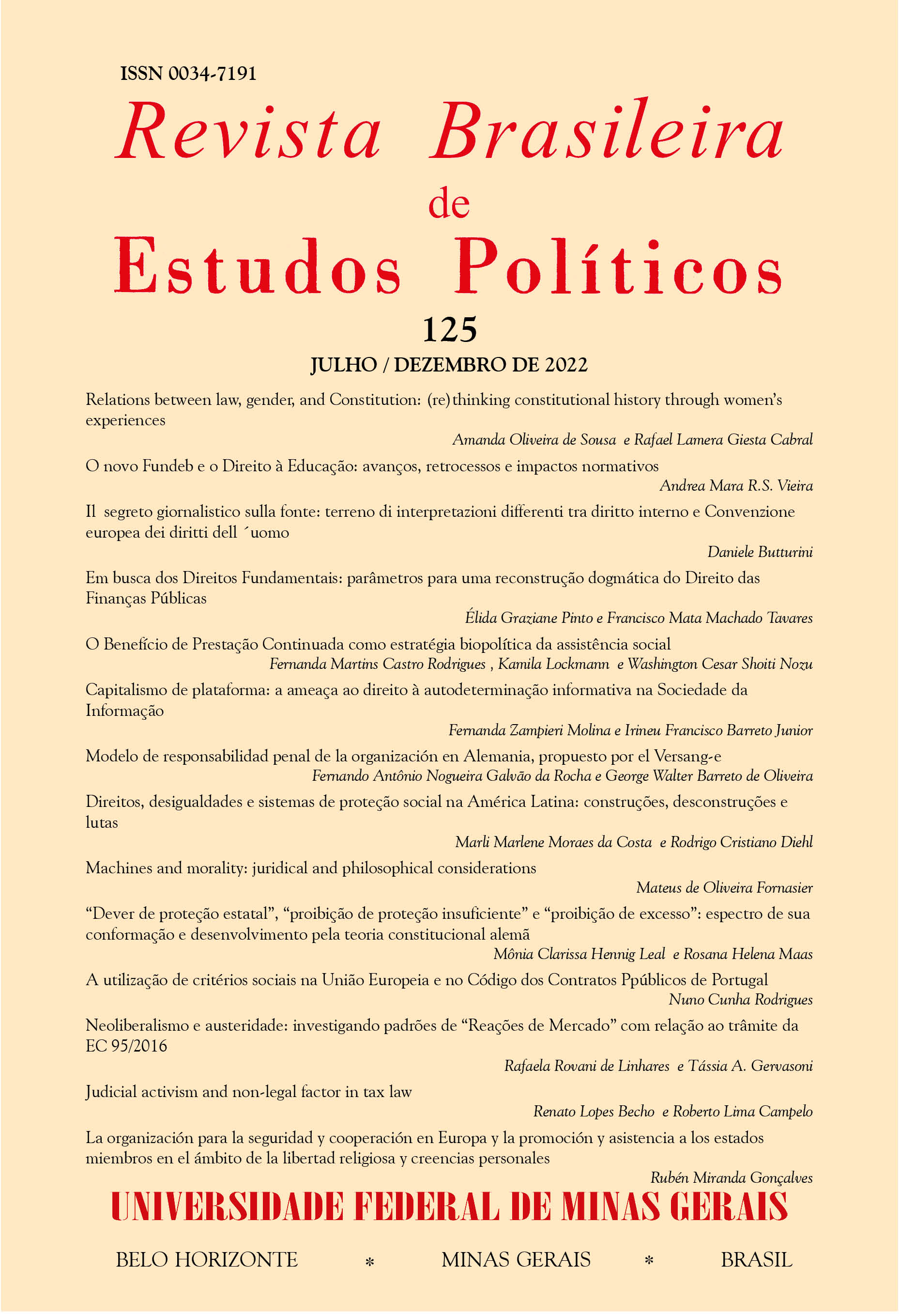
Surveillance Capitalism:
the threat to informational self-determination right in Information Society
DOI:
https://doi.org/10.9732/2022.V125.852Keywords:
Information Society, Informational Self Determination, Surveillance, Personal DataAbstract
This paper aims to clarify on a structural change of the XXI century society, under the Surveillance Capitalism perspective and the treatment given to users' data to build the existent internet platforms, which reinforces the alienation and behavioral control of users for profit and to the detriment of the informational self-determination right. In methodological terms, this research adopted the historic-juridic analysis of the informative self-determination right, with the intent of highlighting the size of today's market Information Society offense, which should guarantee that each citizen is the owner of their own data in front of the multiple possibilities of data collection offered by technology. The study concluded that citizens's self determination right is systematically violated under the current Information Society.
References
ANDRESANI, G.; STAMILE, N. Transparency in internet regulation and governance: arguments and counter-arguments with some methodological reflections. REVISTA BRASILEIRA DE ESTUDOS POLÍTICOS, Belo Horizonte, n. 117, pp. 443-476, jul./dez, 2018.
AZZENA, L. (2021). L’algoritmo nella formazione della deci- sione amministrativa: l’esperienza italiana. REVISTA BRASILEIRA DE ESTUDOS POLÍTICOS, 123, 503-538.
BACHRACH, Yoram; KOSINSKI, Michal; GRAEPELL, Thore; KOHLI, Pushmeet; STILLWELL, David. Personality and Patterns of Facebook Usage. Disponível em: https://dl.acm.org/doi/10.1145/2380718.2380722. Acesso em: 20 out. 2020;
BARBROOK, Richard; CAMERON, Andy. The Californian Ideology. Disponível em: http://www.comune.torino.it/gioart/big/bigguest/riflessioni/californian_engl.pdf. Acesso em: 5 mai. 2020;
BARRETO JUNIOR, I. F., & FERREIRA LEITE, B. S. (2017). Responsabilidade civil dos provedores de aplicações por ato de terceiro na lei 12.965/14 (marco civil da internet). Revista Brasileira De Estudos Políticos, 115. Recuperado de https://pos.direito.ufmg.br/rbep/index.php/rbep/article/view/479.
BARRETO JUNIOR, Irineu Francisco. Proteção da Privacidade e de Dados Pessoais na Internet: O Marco Civil da rede examinado com fundamento nas teorias de Zygmunt Bauman e Manuel Castells. In: DE LUCCA, Newton; SIMÃO FILHO, Adalberto; DE LIMA; Cintia Rosa Pereira. (Org.). Direito & Internet III. São Paulo: Quartier Latin, 2015. p. 100-127.
BARRETO JUNIOR, Irineu Francisco; NASPOLINI, Samyra Haydêe Dal Farra. Proteção de informações no mundo virtual: a LGPD e a determinação de consentimento do titular para tratamento de dados pessoais. Cadernos Adenauer XX (2019), nº3 Proteção de dados pessoais: privacidade versus avanço tecnológico Rio de Janeiro: Fundação Konrad Adenauer, outubro 2019.
BARRETO JUNIOR, Irineu Francisco. PELIZZARI, Bruno Henrique Miniuchi. Bolhas Sociais e seus efeitos na Sociedade da Informação: Ditadura do Algoritmo e Entropia da Internet. Revista de Direito, Governança e Novas Tecnologias. Salvador, 2019.
BENTES, Anna. A gestão algorítmica da atenção: enganchar, conhecer e persuadir. Políticas, Internet e Sociedade. POLÍTICAS, INTERNET E SOCIEDADE, Belo Horizonte, p. 222-234;
BIONI, Bruno Ricardo. Proteção de dados pessoais: a função e os limites do consentimento. 2. Ed. Rio de Janeiro: Forense, 2019;
BRASIL. MEDIDA PROVISÓRIA 954/2020. Disponível em: HTTP://PLANALTO.GOV.BR/CCIVIL_03/_ATO2019-2022/2020/MPV/MPV954.HTM. Acesso em: 12 nov. 2020
BRASIL. SUPREMO TRIBUNAL FEDERAL. MC - ADI 6387/DF, REL. MIN. ROSA WEBER Disponível em: HTTP://WWW.STF.JUS.BR/ARQUIVO/CMS/NOTICIANOTICIASTF/ANEXO/ADI6387MC.PDF. Acesso em: 12 nov. 2020
BRASIL. Lei Geral de Proteção de Dados Pessoais – Lei nº 13.709/2018. Disponível em: http://www.planalto.gov.br/ccivil_03/_ato2015-2018/2018/lei/L13709.htm. Acesso em: 05 nov. 2020;
BRASIL. Constituição da República Federativa do Brasil de 1988. Disponível em: http://www.planalto.gov.br/ccivil_03/constituicao/constituicao.htm.Acesso em: 05 nov. 2020;
BRASIL. Lei nº 10.406 de 10 de janeiro de 2002. Disponível em: http://www.planalto.gov.br/ccivil_03/Leis/2002/l10406.htm. Acesso em: 05 nov. 2020;
BRASIL. Lei n° 12.965 de 23 de abril de 2014. Disponível em: http://www.planalto.gov.br/CCIVIL_03/_Ato2011-2014/2014/Lei/L12965.htm. Acesso em: 05 nov. 2020;
BRUNO, Fernanda; BENTES, Anna; FALTAY, Paulo. Economia psíquica dos algoritmos: quando o laboratório é o mundo. REVISTA FAMECOS, Porto Alegre, v. 26, nº3, set-dez, 2018;
DJICK, José Van. A Sociedade da Plataforma: entrevista com José van Dijck. Disponível em: https://digilabour.com.br/2019/03/06/a-sociedade-da-plataforma-entrevista-com-jose-van-dijck/. Acesso em: 20 out. 2020;
DURANTE, Massimo. A construção online da identidade pessoal através da confiança e da privacidade. INFORMAÇÕES 2, p. 594–620, 2011;
EYAL, Nir. (ENGAJADO): Como construir produtos e serviços formadores de hábitos. São Paulo, Alfacon, 2020.
EYEAL, Nir. Hooked. Penguin Books, 2014.
FLORIDI, Luciano. The Fourth Revolution: How the Infosphere is Reshaping Human Reality. Ed. Oxford University Press, 2014;
KOSINSKI, Michal; STILLWELL, David; GRAEPEL, T hore. Características e atributos privados são previsíveis a partir de registros digitais do comportamento humano. Disponível em: https://doi.org/10.1073/pnas.1218772110. Acesso em: 21 out. 2020;
KOTLER, Philip; KELLER, Kevin Lane Administração de Marketing. 12. Ed. São Paulo: Pearson Prentice Hall, 2006;
RODOTÀ, Stefano. A vida na sociedade da vigilância: a privacidade hoje. Organização, seleção e apresentação de Maria Celina Bodin de Moraes. Tradução: Danilo Doneda e Luciana Cabral Doneda. Rio de Janeiro: Renovar, 2008;
SCHECHTMAN, Marya. Staying Alive: personal identity, practical concerns, and the unity of a life. Oxford: Oxford University Press, 2014;
SIEGEL, Eric. Análise Preditiva. Rio de Janeiro: Alta Books, 2017;
ZUBOFF, SHOSHANA. Big other: capitalismo de vigilância e perspectivas para uma civilização de informação. In: BRUNO, Fernanda; CARDOSO, Bruno; KANASHIRO, Marta; GUILHON, Luciana; MELGAÇO, Lucas et al. (Org.). Tecnopolíticas da vigilância: perspectivas da margem. São Paulo: Boitempo, 2018.
Downloads
Published
Issue
Section
License
Autores que publicam nesta revista concordam com os seguintes termos:
Os autores mantêm os direitos autorais e concedem à Revista Brasileira de Estudos Políticos o direito de primeira publicação, com o trabalho simultaneamente licenciado sob a Licença Creative Commons Attribution. Essa licença permite o compartilhamento do trabalho com reconhecimento da autoria e publicação inicial nesta revista, desde que sem fins comerciais.
É permitido ainda que outros distribuam, adaptem e criem a partir do seu trabalho, sem fins comerciais, desde que lhe atribuam o devido crédito pela criação original.
Autores têm autorização para assumir contratos adicionais separadamente, para distribuição não-exclusiva da versão do trabalho publicada nesta revista (ex.: publicar em repositório institucional ou como capítulo de livro), com reconhecimento de autoria e publicação inicial nesta revista.
Autores têm permissão e são estimulados a publicar e distribuir seu trabalho online após o processo editorial, já que isso pode gerar alterações produtivas, bem como aumentar o impacto e a citação do trabalho publicado.
Authors who publish in this journal agree to the following terms:
The authors maintain the copyright and grant the Brazilian Journal of Political Studies the right of first publication, with the work simultaneously licensed under the Creative Commons Attribution License. This license allows the sharing of the work with authorship recognition and initial publication in this journal, as long as it is not for commercial purposes.
It is also allowed that others distribute, adapt and create from their work, without commercial purposes, as long as they attribute due credit for the original creation.
Authors are allowed to enter into additional contracts separately for non-exclusive distribution of the version of the work published in this journal (e.g., publish in an institutional repository or as a book chapter), with authorship recognition and initial publication in this journal.
Authors are allowed and encouraged to publish and distribute their work online after the editorial process, as this can generate productive changes as well as increase the impact and citation of the published work.