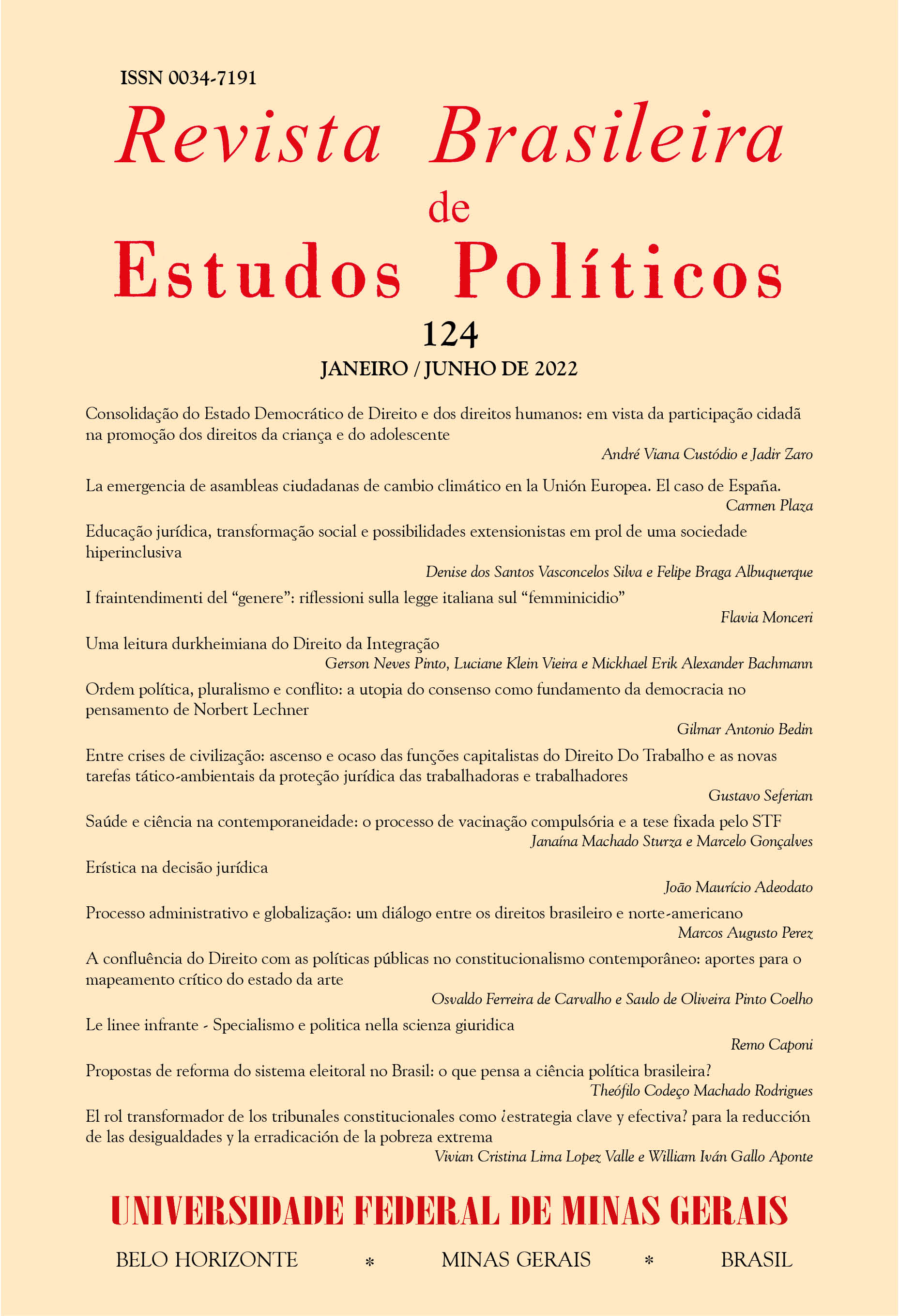
ERISTICS IN THE LEGAL DECISION
DOI:
https://doi.org/10.9732/2022.V124.867Keywords:
eristic rhetoric, theory of legal argumentation, theory of legal decision, lying and languageAbstract
The paper intends to define what should be understood by theory of legal argumentation, focusing the role of eristics and its relationship with the concepts of persuasion – to which legal argumentation is traditionally reduced – and decision. The methodology consists of an etymological archeology or conceptual phenomenology of the main concepts, starting from ancient Greece, where rhetoric was born. The text also suggests that complex contemporary society pulverizes its decision centers and expands the eristic character of the legal discourse. And it seeks the anthropological foundations of the eristic decision in the impossibility to distinguish lying in human language and consequently in communication.
References
ALEXY, Robert. Theorie der juristischen Argumentation – die Theorie des rationalen Diskurses als Theorie der juristischen Begründung. Frankfurt a.M.: Suhrkamp, 1978.
ARENDT, Hannah. Lying in politics – Reflections on the Pentagon papers, in: Crises of the Republic. New York/London: Harvest/HBJ, 1972 p. 1-47.
ARENDT, Hannah. What is authority?, in: Between past and future – Eight exercises in political thought. New York: The Viking Press, 1980, p. 91-141.
ARENDT, Hannah. Truth and politics, in: Between past and future – Eight exercises in political thought. New York: The Viking Press, 1980, p. 227-264.
ARISTOTLE. On sophistical refutations, in The works of Aristotle, trad. W. A. Pickard-Cambridge, Col. Great Books of the Western World. Chicago: Encyclopaedia Britannica, 1990a, vol. 7.
ARISTOTLE. Metaphysics, in The works of Aristotle, trad. W. D. Ross, Col. Great Books of the Western World. Chicago: Encyclopaedia Britannica, 1990b, vol. 7.
ARISTOTLE. Rhetoric, in The works of Aristotle, trad. W. Rhys Roberts, Col. Great Books of the Western World. Chicago: Encyclopaedia Britannica, 1990c, vol. 8.
BARATA-MOURA, José. Da mentira: um ensaio – transbordante de errores. Lisboa: Editorial Caminho, 2007.
BARILLI, Renato. Retórica. Lisboa: Editorial Presença, 1985.
BATTISTELLI, Luigi. A mentira, trad. Fernando de Miranda. São Paulo: Saraiva, 1945.
BOYER, Pascal. Pascal Boyer's blog: http://cognitionandculture.net/blogs/pascal-boyer/so-youre-saying-we-should-live-like-lobsters-or-why-does-politics-make-us-stupid/ “So you’re saying … we should live like lobsters?” or: Why does politics make us stupid? Acesso em 15.11.2020.
COLE, Thomas. Who was Corax? Illinois Classical Studies, Vol. 16, No. 1/2 (Spring/Fall 1991). Urbana–Champaign: University of Illinois Press.
CONJUR (Consultor Jurídico). https://www.conjur.com.br/dl/voto-gilmar-mendes-adi-reeleicao.pdf.
DERRIDA, Jacques. História da mentira: prolegômenos. Estudos Avançados 10 (27), 1996, p. 7-39.
DIARIO LA LEY. Primera sentencia europea que declara ilegal un algoritmo de evaluación de características personales de los ciudadanos.
(https://diariolaley.laleynext.es/Content/Documento.aspx?params=H4sIAAAAAAAEAMtMSbH1czUwMDAyNDa3NDJUK0stKs7Mz7M1MjACC6rl5aekhrg425bmpaSmZealpoCUZKZVuuQnh1QWpNqmJeYUp6qlJuXnZ6OYFA8zAQCfSdkrYwAAAA==WKE). Acesso em 24 de outubro de 2020.
FERRATER MORA, José. Diccionario de Filosofía, 2 Tomos. Buenos Aires: Editorial Sudamericana, 1968.
FRIEDRICH, George. On the Difference Between Ambiguity, Vagueness, and Indeterminacy. https://www.researchgate.net/publication/316993788. Acesso em 04 de janeiro de 2021.
HOBBES, Thomas. Leviathan or Matter, form and power of a state ecclesiastical and civil. Col. Great Books of the Western World. Chicago: Encyclopaedia Britannica, 1990, v. 21.
HARARI, Yuval Noah. Homo Deus. A brief history of tomorrow. London: Vintage, 2017.
KANT, Immanuel. Über ein vermeintes Recht aus Menschenliebe zu lügen. In: KANT, Immanuel. Die Metaphysik der Sitten. Werkausgabe — in zwölf Bände. WEISCHEDEL, Wilhelm (Hrsg.). Frankfurt a.M.: Suhrkamp, 1977, vol. VIII, p. 637-643.
LAUSBERG, Heinrich. Elementos de retórica literária. Tradução, prefácio e aditamentos de R. M. Rosado Fernandes. Lisboa: Calouste Gulbenkian, 2004 (5ª ed.).
LIAKOPOULOS, Miltos. Análise argumentativa. In: BAUER, Martin W. e GASKELL, George. Pesquisa qualitativa com texto, imagem e som – um manual prático. Petrópolis: Vozes, 2005, p. 218-243.
LUHMANN, Niklas. Ausdifferenzierung des Rechts. Frankfurt a. M.: Suhrkamp, 1981.
McCLOSKEY, D. N. A retórica da economia, in: REGO, José Marcio (org.). Retórica na economia. São Paulo: Editora 34, 1996.
PLATO. Euthydemus, in The dialogues of Plato, trad. J. Harward, Col. Great Books of the Western World, Chicago: Encyclopaedia Britannica, 1990a, vol. 6.
PLATO. Sophist, in The dialogues of Plato, trad. J. Harward, Col. Great Books of the Western World, Chicago: Encyclopaedia Britannica, 1990b, vol. 6.
RUSSELL, Bertrand. History of Western philosophy — and its connection with Political and social circumstances from the earliest times to the present day. London: Routledge, 1993.
RUSSELL, Bertrand. Religion and science. London: Thornton Butterworth, 1935.
SCHLIEFFEN, Katharina von. Rhetorische Rechtstheorie, in Gert Ueding (Hrsg.). Historisches Wörterbuch der Rhetorik, Band 8. Tübingen: Max Niemeyer Verlag, 2007, p. 197-214.
SCHOPENHAUER, Arthur. Eristische Dialektik: Die Kunst, Recht zu behalten. https://TheVirtualLibrary.org. 2014. Acesso em 20.01.2021.
SMITH, David Livingstone. Porque mentimos – Os fundamentos biológicos e psicológicos da mentira. São Paulo: Campus/Elsevier), 2005.
SOBOTA, Katharina. Rhetorisches Seismogramm – eine neue Methode in der Rechtswissenschaft. Juristenzeitung. Digizeitschriften, vol. 47, Issue 5, 1992.
UEDING, Gert (Hrsg.). Historisches Wörterbuch der Rhetorik, Band 2. Darmstadt: Wissenschaftliche Buchgesellschaft, 1994.
WINTER, Steven L. Transcendental nonsense, metaphoric reasoning, and the cognitive stakes for Law. University of Pennsylvania Law Review, 11. Pittsburg: University of Pennsylvania, vol. 11, nr. 137, april 1989.
Downloads
Published
Issue
Section
License
Autores que publicam nesta revista concordam com os seguintes termos:
Os autores mantêm os direitos autorais e concedem à Revista Brasileira de Estudos Políticos o direito de primeira publicação, com o trabalho simultaneamente licenciado sob a Licença Creative Commons Attribution. Essa licença permite o compartilhamento do trabalho com reconhecimento da autoria e publicação inicial nesta revista, desde que sem fins comerciais.
É permitido ainda que outros distribuam, adaptem e criem a partir do seu trabalho, sem fins comerciais, desde que lhe atribuam o devido crédito pela criação original.
Autores têm autorização para assumir contratos adicionais separadamente, para distribuição não-exclusiva da versão do trabalho publicada nesta revista (ex.: publicar em repositório institucional ou como capítulo de livro), com reconhecimento de autoria e publicação inicial nesta revista.
Autores têm permissão e são estimulados a publicar e distribuir seu trabalho online após o processo editorial, já que isso pode gerar alterações produtivas, bem como aumentar o impacto e a citação do trabalho publicado.
Authors who publish in this journal agree to the following terms:
The authors maintain the copyright and grant the Brazilian Journal of Political Studies the right of first publication, with the work simultaneously licensed under the Creative Commons Attribution License. This license allows the sharing of the work with authorship recognition and initial publication in this journal, as long as it is not for commercial purposes.
It is also allowed that others distribute, adapt and create from their work, without commercial purposes, as long as they attribute due credit for the original creation.
Authors are allowed to enter into additional contracts separately for non-exclusive distribution of the version of the work published in this journal (e.g., publish in an institutional repository or as a book chapter), with authorship recognition and initial publication in this journal.
Authors are allowed and encouraged to publish and distribute their work online after the editorial process, as this can generate productive changes as well as increase the impact and citation of the published work.