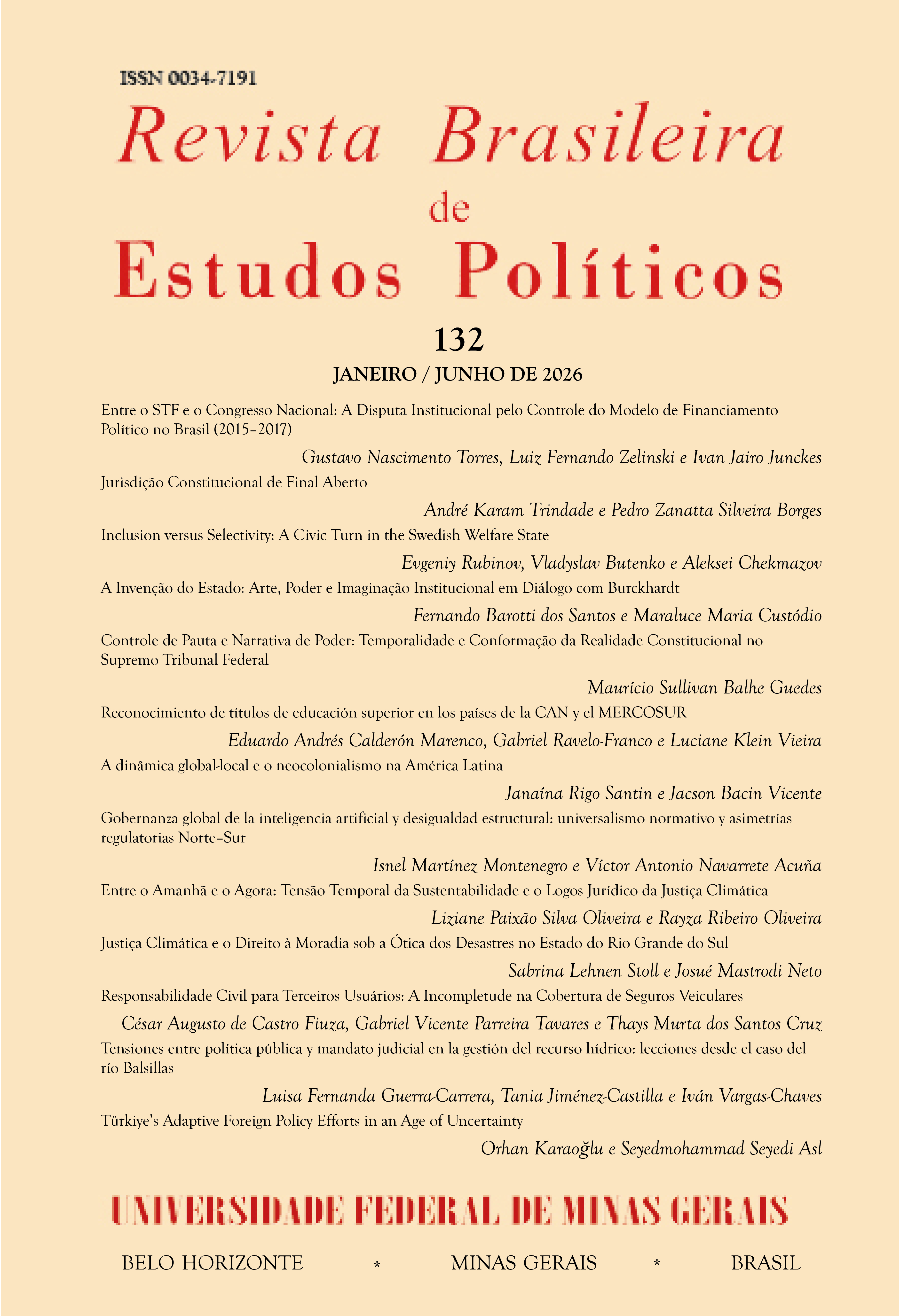
Global governance of artificial intelligence and structural inequality: normative universalism and North-South regulatory asymmetries
universalismo normativo y asimetrías regulatorias Norte–Sur
DOI:
https://doi.org/10.9732/Keywords:
global governance; artificial intelligence; structural inequality; North-South; regulation; soft law.Abstract
The global governance of artificial intelligence (AI) has consolidated in the last decade as a heterogeneous normative regime, composed of ethical principles, recommendations, risk management frameworks, technical standards and, in certain contexts, legally binding regulations. These instruments, promoted by central actors in global governance, including the Organisation for Economic Co-operation and Development (OECD), the G7, the European Union and the United Nations system, particularly UNESCO, are articulated around principles of human-centricity, protection of fundamental rights, security and sustainable development. However, this article argues that, despite its universalist formulation, the normative architecture of global AI governance tends to privilege instruments whose effective implementation requires high institutional, regulatory and technological capacities, which can generate asymmetric distributive effects between Global North and Global South States. Based on a comparative-legal analysis of discourses and regulatory frameworks from the OECD, the G7, UNESCO, the European Union Artificial Intelligence Act (AI Act) and the case of Chile, the study identifies a structural tension between normative universalism and material implementation asymmetries. The article concludes that the current architecture of global AI governance, although formally oriented towards harmonization and protection, contributes to the reproduction of regulatory advantages in favor of actors with greater capacities, limiting the material effectiveness of the proclaimed normative objectives.
References
ABBOTT, K. W.; GENSCHEL, P.; SNIDAL, D.; ZANGL, B. Two logics of indirect governance: Delegation and orchestration. British Journal of Political Science, v. 46, n. 4, p. 719–729, 2016. DOI: https://doi.org/10.1017/S0007123414000593.
ALMADA, M.; RADU, A. The Brussels side-effect: How the AI Act can reduce the global reach of EU policy. German Law Journal, v. 24, p. 646–670, 2024. DOI: http://dx.doi.org/10.2139/ssrn.4592006.
BABBIE, E. The practice of social research. 14. ed. [S.l.]: Cengage Learning, 2016.
BRAVO-PLACERES, I. Entre algoritmos y justicia: la danza regulatoria de la inteligencia artificial. Iustitia Socialis: Revista Arbitrada de Ciencias Jurídicas y Criminalísticas, v. 10, n. 18, p. 5-25, 2025. DOI: https://doi.org/10.35381/racji.v10i18.4338.
BÜTHE, T.; MATTLI, W. The new global rulers: The privatization of regulation in the world economy. Princeton: Princeton University Press, 2011.
CÁMARA DE DIPUTADAS Y DIPUTADOS DE CHILE. Proyecto de ley que regula los sistemas de inteligencia artificial, la robótica y las tecnologías conexas, en sus distintas aplicaciones (Boletín N° 16821-19). Valparaíso: Cámara de Diputadas y Diputados, 2024. https://www.camara.cl/legislacion/ProyectosDeLey/tramitacion.aspx?prmID=17429&prmBOLETIN=1784
Cardona Hernández, L. C., Mario Fisgativa, C. Experiencias curriculares y de extensión social para la construcción de paz en la educación superior. Sophia, 22(1), e1404, 2026.https://doi.org/10.18634/sophiaj.22v.1i.1404
Coronado Peña, J. J., Yuri Jiménez Lozano, M., Burbano Daz, A. K., Mantilla-Mendoza, J D. Incidencia del liderazgo educativo docente en los procesos de aprendizaje en básica secundaria. Sophia, v. 22, (1), e1551, 2026. DOI: https://doi.org/10.18634/sophiaj.22v.1i.1551
COULDRY, N.; MEJIAS, U. A. The costs of connection: How data is colonizing human life and appropriating it for capitalism. Stanford: Stanford University Press, 2019.
CRAWFORD, K. Atlas of AI: Power, politics, and the planetary costs of artificial intelligence. New Haven: Yale University Press, 2021.
CRESWELL, J. W.; CRESWELL, J. D. Research design: Qualitative, quantitative, and mixed methods approaches. 5. ed. [S.l.]: SAGE, 2017.
de Oliveira Carneiro, M. R. Pessoas em Situação de Rua, Raça e Danos da Escravidão: a racialização como mecanismo de enfrentamento do racismo estrutural. Inciso. 28(1), 2026. https://revistas.ugca.edu.co/index.php/inciso/article/view/1612
DEVIN, G. (Org.). Resources and applied methods in international relations. [S.l.]: Palgrave, 2018.
DIMAGGIO, P. J.; POWELL, W. W. The iron cage revisited: Institutional isomorphism and collective rationality in organizational fields. American Sociological Review, v. 48, n. 2, p. 147–160, 1983.
EUROPEAN UNION. Regulation (EU) 2024/1689 of the European Parliament and of the Council laying down harmonised rules on artificial intelligence (Artificial Intelligence Act). Official Journal of the European Union, 2024.
G7. Hiroshima process international guiding principles for organizations developing advanced AI systems. [S.l.]: Government of Japan, 2023.
GILL, S. R. Gobernanza Global: “Cómo era, es y debería ser”. Una reflexión crítica. Foro internacional, v. 60, n. 4, p. 1261-1293, 2020. DOI: https://doi.org/10.24201/fi.v60i4.2800.
GLOBAL PARTNERSHIP ON ARTIFICIAL INTELLIGENCE; ORGANIZACIÓN PARA LA COOPERACIÓN Y EL DESARROLLO ECONÓMICOS (OCDE). Políticas, datos y análisis para una inteligencia artificial confiable. 2024. Disponível em: https://gpai.ai/. Acesso em: 24 abr. 2026.
GUAÑA MOYA, J.; RICALDE PALOMINO, H.; PIZARRO ESQUIVEL, N. Gobernanza, ética y regulación del uso de IA en organizaciones públicas y privadas. RCK, v. 5, n. 1, 2026. DOI: https://doi.org/10.62943/rck.v5n1.2026.458.
GUERRERO-SIERRA, H. F.; DE LA PEÑA, N.; ROJAS MORA, J. E. Algocracias y crisis de legitimidad: modelos globales de gobernanza de la inteligencia artificial y erosión democrática. Análisis Político, v. 38, n. 111, p. 255-278, 2025. DOI: https://doi.org/10.15446/anpol.v38n111.125141.
HINCAPIÉ, S. Gobernanza ambiental global y derechos de la naturaleza en América Latina. Revista Derecho del Estado, n. 54, p. 277-305, 2023. DOI: https://doi.org/10.18601/01229893.n54.09.
JOBIN, A.; IENCA, M.; VAYENA, E. The global landscape of AI ethics guidelines. Nature Machine Intelligence, v. 1, p. 389–399, 2019. DOI: https://doi.org/10.1038/s42256-019-0088-2.
LOPE-CERVANTES, D. S. et al. La inteligencia artificial generativa-productiva en el derecho constitucional comparado: una revisión sistemática. Revista InveCom, v. 6, n. 2, e602057, 2026. DOI: https://doi.org/10.5281/zenodo.16415797.
MARIÑO-ARÉVALO, A.; MUÑOZ-MARTÍNEZ, I. T. Isomorfismo y convergencia: vinculación estratégica de los Objetivos de Desarrollo Sostenible a las escuelas de negocio latinoamericanas. Revista Lasallista de Investigación, v. 20, n. 2, p. 57-78, 2023. DOI: https://doi.org/10.22507/rli.v20n2a4.
MARTÍNEZ MONTENEGRO, I. Sobre los métodos de la investigación jurídica. Revista chilena de derecho y ciencia política, v. 14, n. 1, 2023. DOI: https://dx.doi.org/10.7770/rchdcp-v14n1-art312.
MARTÍNEZ MONTENEGRO, I. El problema de investigación jurídica: claves metodológicas para una formulación pertinente. Revista chilena de derecho y ciencia política, v. 16, n. 1, 2025. DOI: https://dx.doi.org/10.7770/rchdcp-v16n1-art503.
MARTÍNEZ MONTENEGRO, I. Entre métricas, inteligencia artificial y ética editorial: desafíos de la publicación científica desde el Sur Global. Revista Chilena de Derecho y Ciencia Política, v. 17, n. 1, 2026. Disponível em: https://derechoycienciapolitica.uct.cl/index.php/RDCP/article/view/666. Acesso em: 24 abr. 2026.
MARTÍNEZ MONTENEGRO, I.; NAVARRETE ACUÑA, V. A.; ROJAS BAUVIGNET, S. Justicia digital en el Sur Global y Europa: neutralidad tecnológica, desigualdad y gobernanza democrática con miradas para Chile. Revista de la Facultad de Derecho, n. 87, p. 163–196, 2025. DOI: https://doi.org/10.12818/P.0304-2340.2025v87p163.
MARTÍNEZ RUIZ, W. L.; CUBIDES GUZMÁN, Z. A. Jerga docente: una mirada a sus transformaciones desde la mediación tecnológica de los procesos de enseñanza. Sophia Educación, v. 21, n. 1, e1507, 2025. DOI: https://doi.org/10.18634/sophiaj.21v.1i.1507.
MINISTERIO DE CIENCIA, TECNOLOGÍA, CONOCIMIENTO E INNOVACIÓN. Política nacional de inteligencia artificial: Actualización 2024. Santiago: Gobierno de Chile, 2024. Disponível em: https://minciencia.gob.cl. Acesso em: 24 abr. 2026.
Moreno Gómez, J. A. La imposibilidad de la educación en Colombia para ser constructora de paz: Una mirada desde el pensamiento crítico de Franz Hinkelammert. Sophia, 21(1), e1508, 2025. https://doi.org/10.18634/sophiaj.21v.1i.1508
MUJICA-SEQUERA, R. M.; GARCÍA-HEREDIA, N. B. Entre Códigos y Corazones: Investigación e Inteligencia Artificial hacia una Tecnología más Humana. Revista Tecnológica-Educativa Docentes 2.0, v. 18, n. 2, p. 337-345, 2025. DOI: https://doi.org/10.37843/rted.v18i2.724.
NACIONES UNIDAS. Assembleia Geral. Seizing the opportunities of safe, secure and trustworthy artificial intelligence systems for sustainable development (A/RES/78/265). Nova York: ONU, 2024.
OECD. OECD principles on artificial intelligence. Paris: OECD Publishing, 2019. DOI: https://doi.org/10.1787/cc92d9c5-en.
OECD. Recommendation of the Council on Artificial Intelligence (updated). Paris: OECD Publishing, 2024. Disponível em: https://legalinstruments.oecd.org/en/instruments/OECD-LEGAL-0449. Acesso em: 24 abr. 2026.
PERRI 6; BELLAMY, C. Principles of methodology: Research design in social science. [S.l.]: SAGE, 2011.
RADU, R. Steering the governance of artificial intelligence: National strategies in perspective. Policy and Society, v. 40, n. 2, p. 178–193, 2021. DOI: https://doi.org/10.1080/14494035.2021.1929728.
ROBSON, C.; MCCARTAN, K. Real world research. 4. ed. [S.l.]: John Wiley, 2016.
SÁNCHEZ ACEVEDO, M. E. La inteligencia artificial en el sector público y su límite respecto de los derechos fundamentales. Estudios constitucionales, v. 20, n. 2, p. 257-284, 2022. DOI: https://dx.doi.org/10.4067/S0718-52002022000200257.
Toledo Mazariegos, A.D., Gallardo Loya, R.C. Flores Ruíz. R. Los procesos de repatriación de Estados Unidos a México: Impacto económico y vulneración de los derechos humanos. Inciso28(1), 2026. https://revistas.ugca.edu.co/index.php/inciso/article/view/1636
UNESCO. Recommendation on the ethics of artificial intelligence. Paris: UNESCO Publishing, 2021.
UNESCO. Ethics of artificial intelligence: Readiness assessment methodology. Paris: UNESCO Publishing, 2025. Disponível em: https://www.unesco.org/en/artificial-intelligence/recommendation-ethics. Acesso em: 24 abr. 2026.
VÉRTIZ-QUEREVALÚ, P. J.; SUAREZ-ALMEIRA, M. A.; ZEGARRA-UGARTE, S. J.; PORTILLO-CALSINA, D. J. El impacto de las políticas de rendición de cuentas en la gobernanza: una revisión sistemática. Revista InveCom, v. 6, n. 2, e602016, 2026. DOI: https://doi.org/10.5281/zenodo.15792844.
WILLIAMS, M. Making sense of social research. [S.l.]: SAGE, 2003.
Downloads
Published
Issue
Section
License
Autores que publicam nesta revista concordam com os seguintes termos:
Os autores mantêm os direitos autorais e concedem à Revista Brasileira de Estudos Políticos o direito de primeira publicação, com o trabalho simultaneamente licenciado sob a Licença Creative Commons Attribution. Essa licença permite o compartilhamento do trabalho com reconhecimento da autoria e publicação inicial nesta revista, desde que sem fins comerciais.
É permitido ainda que outros distribuam, adaptem e criem a partir do seu trabalho, sem fins comerciais, desde que lhe atribuam o devido crédito pela criação original.
Autores têm autorização para assumir contratos adicionais separadamente, para distribuição não-exclusiva da versão do trabalho publicada nesta revista (ex.: publicar em repositório institucional ou como capítulo de livro), com reconhecimento de autoria e publicação inicial nesta revista.
Autores têm permissão e são estimulados a publicar e distribuir seu trabalho online após o processo editorial, já que isso pode gerar alterações produtivas, bem como aumentar o impacto e a citação do trabalho publicado.
Authors who publish in this journal agree to the following terms:
The authors maintain the copyright and grant the Brazilian Journal of Political Studies the right of first publication, with the work simultaneously licensed under the Creative Commons Attribution License. This license allows the sharing of the work with authorship recognition and initial publication in this journal, as long as it is not for commercial purposes.
It is also allowed that others distribute, adapt and create from their work, without commercial purposes, as long as they attribute due credit for the original creation.
Authors are allowed to enter into additional contracts separately for non-exclusive distribution of the version of the work published in this journal (e.g., publish in an institutional repository or as a book chapter), with authorship recognition and initial publication in this journal.
Authors are allowed and encouraged to publish and distribute their work online after the editorial process, as this can generate productive changes as well as increase the impact and citation of the published work.