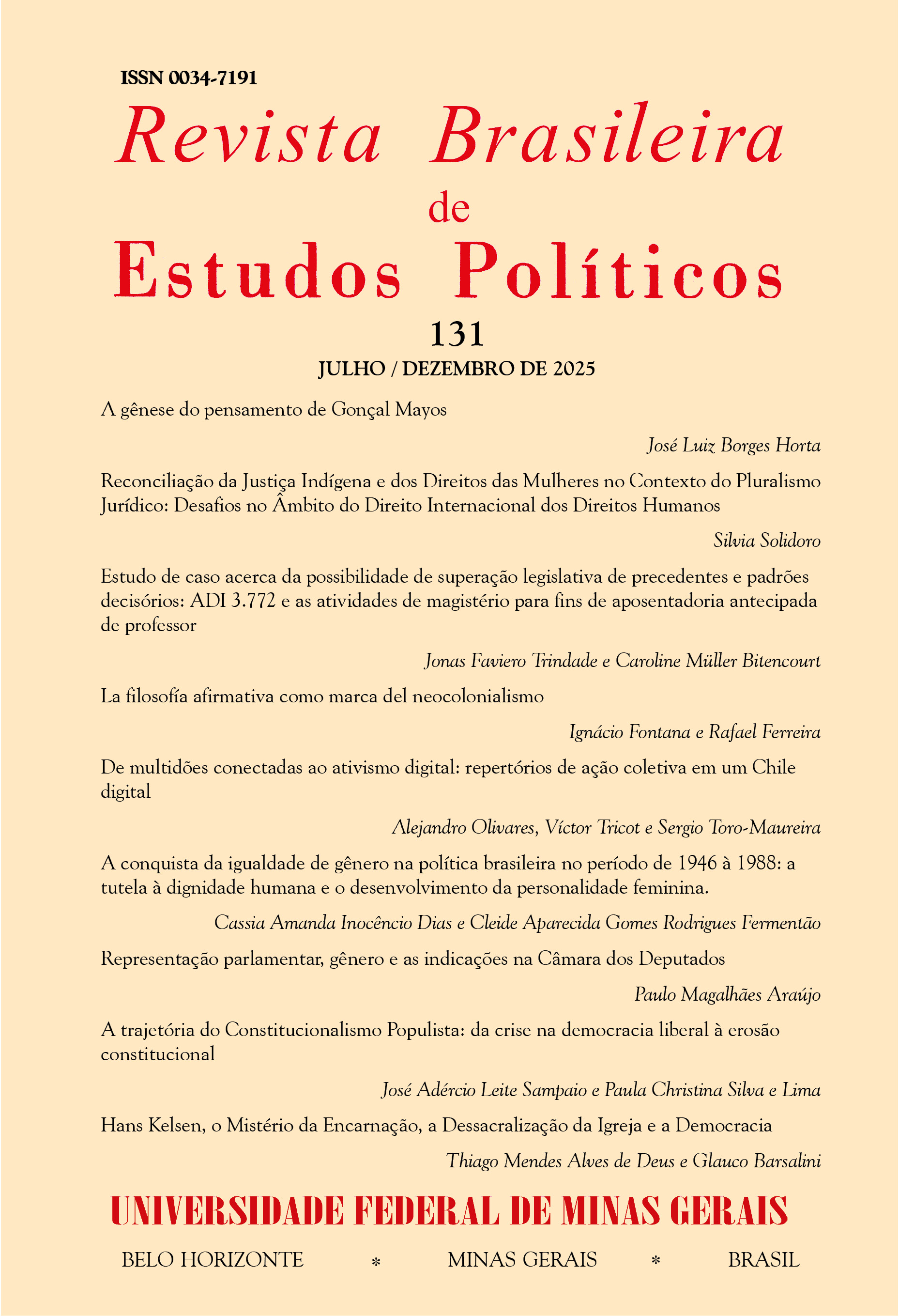
Reconciling Indigenous Justice and Women’s Rights within Legal Pluralism:
Challenges under International Human Rights Law
DOI:
https://doi.org/10.9732/2025.V131.1409Palavras-chave:
Justiça Indígena; Mulheres Indígenas; Pluralismo Jurídico; Direito Internacional dos Direitos Humanos; Igualdade de GêneroResumo
O presente artigo examina questões relacionadas ao direito das mulheres indígenas de acesso à justiça em contextos de pluralismo jurídico, destacando a tensão entre a relevância cultural dos sistemas tradicionais e os riscos impostos pelas normas patriarcais. A análise começa revisando o quadro jurídico internacional que reconhece os povos indígenas como titulares de direitos distintos, com foco na Declaração das Nações Unidas sobre os Direitos dos Povos Indígenas (2007), que reformulou a relação entre direitos coletivos e individuais. Em seguida, analisa a prática de órgãos de tratados sob acordos universais, com ênfase na Convenção sobre a Eliminação de Todas as Formas de Discriminação contra as Mulheres (CEDAW), que adota uma perspectiva de gênero explícita. Com base nisso, o artigo identifica dois modelos principais: um que prioriza os direitos individuais das mulheres, exigindo restrições à jurisdição indígena; e outro, mais equilibrado. Este último modelo, defendido principalmente pelo Comitê da CEDAW e cada vez mais apoiado por Procedimentos Especiais da ONU, reflete um padrão emergente que pode orientar Estados na criação de marcos jurídicos que promovam o autogoverno indígena e garantam os direitos das mulheres, por meio de uma abordagem colaborativa entre sistemas tradicionais e nacionais que envolva ativamente as mulheres.
Referências
ANAYA, James. International Human Rights and Indigenous Peoples: The Move Towards the Multicultural State. In: Arizona Journal of International and Comparative Law, v. 21, n. 1, pp. 13-61, 2004.
ATREY, Shreya. Intersectional Discrimination. Oxford: Oxford University Press, 2019.
BAGNI, Silvia; RODRÍGUEZ CAGUANA, Adriana. Legal pluralism and intercultural justice: a comparative case study among Bolivia, Colombia and Ecuador. In: Revista General de Derecho Público Comparado, v. 31, pp. 1-24, 2022.
BALDIN, Serena. Giustizia indigena e giustizia costituzionale interculturale nell’ordinamento boliviano. In: D’ALESSANDRO, Chiara Antonia; MARCHESE, Claudia (eds.). Ius Dicere in a Globalized World, A Comparative Overview. v. 1. Rome: Roma TrE-Press. pp. 359-392, 2018.
BARNABAS, Sylvanus Gbendazhi. The Legal Status of the United Nations Declaration on the Rights of Indigenous Peoples (2007) in Contemporary International Human Rights Law. In: International Human Rights Law Review, v. 6, n. 2, pp. 242-261, 2017.
BONFANTI, Angelica. Diversità culturale, pratiche tradizionali dannose e diritti umani. Un’analisi di diritto internazionale pubblico e privato. Torino: Giappichelli, 2024.
CCPR, Human Rights Committee of the International Covenant on Civil and Political Rights. General Comment No. 23: Article 27 (Rights of Minorities), doc. CCPR/C/21/Rev.1/Add.5. United Nations, 8 April 1994.
CCPR, Human Rights Committee of the International Covenant on Civil and Political Rights. General Comment No. 28: Article 3 (The Equality of Rights Between Men and Women), doc. CCPR/C/21/Rev.1/Add.10. United Nations, 29 March 2000.
CCPR, Human Rights Committee of the International Covenant on Civil and Political Rights. General Comment No. 32, Article 14: Right to equality before courts and tribunals and to a fair trial, doc. CCPR/C/GC/32. United Nations, 23 August 2007.
CCPR, Human Rights Committee of the International Covenant on Civil and Political Rights. Concluding observations on the third periodic report of the Plurinational State of Bolivia, doc. CCPR/C/BOL/CO/3. United Nations, 6 December 2013.
CEDAW, Committee on the Elimination of Discrimination against Women. General recommendation No. 28 on the core obligations of States Parties under article 2 of the Convention on the Elimination of All Forms of Discrimination against Women, doc. CEDAW/C/GC/28. United Nations, 16 December 2010.
CEDAW, Committee on the Elimination of Discrimination against Women. Concluding observations of the Committee on the Elimination of Discrimination against Women, Mexico, doc. CEDAW/C/MEX/CO/7-8. United Nations, 7 August 2012.
CEDAW, Committee on the Elimination of Discrimination against Women. General recommendation No. 33 on women’s access to justice, doc. CEDAW/C/GC/33. United Nations, 3 August 2015.
CEDAW, Committee on the Elimination of Discrimination against Women. General recommendation No. 34 (2016) on the rights of rural women, doc. CEDAW/C/GC/34. United Nations, 7 March 2016.
CEDAW, Committee on the Elimination of Discrimination against Women. General recommendation No. 35 (2017) on gender-based violence against women, updating general recommendation No. 19 (1992), doc. CEDAW/C/GC/35. United Nations, 26 July 2017.
CEDAW, Committee on the Elimination of Discrimination against Women. General recommendation No. 39 (2022) on the rights of Indigenous women and girls, doc. CEDAW/C/GC/39. United Nations, 31 October 2022.
CERD, Committee on the Elimination of Racial Discrimination. General Recommendation No. 23: Indigenous Peoples, doc. A/52/18, annex V. United Nations, 18 August 1997.
CERD, Committee on the Elimination of Racial Discrimination. Consideration of reports submitted by States Parties under Article 9 of the Convention. Concluding observations of the Committee on the Elimination of Racial Discrimination, Ethiopia, doc. CERD/C/ETH/CO/7-16. United Nations, 7 September 2009.
CERD, Committee on the Elimination of Racial Discrimination. Consideration of reports submitted by States Parties under Article 9 of the Convention. Concluding observations of the Committee on the Elimination of Racial Discrimination, Canada, doc. CERD/C/CAN/CO/19-20. United Nations, 4 April 2012.
CERD, Committee on the Elimination of Racial Discrimination. Opinion adopted by the Committee under article 14 of the Convention, concerning communication No. 61/2017, doc. CERD/C/106/D/61/2017. United Nations, 26 July 2022.
CERD, Committee on the Elimination of Racial Discrimination. Concluding observations on the twenty-fifth periodic report of Ecuador, doc. CERD/C/ECU/CO/25. United Nations, 23 December 2024.
CIRNAC, Crown‑Indigenous Relations and Northern Affairs Canada. The Government of Canada’s Approach to Implementation of the Inherent Right and the Negotiation of Aboriginal Self-Government. Ottawa: Government of Canada, 2023. Available at: <https://www.rcaanc-cirnac.gc.ca/eng/1100100031843/1539869205136>.
COMMISSION ON HUMAN RIGHTS, United Nations Commission on Human Rights. Organization of the work of the session. Report of the Working Group established in accordance with Commission on Human Rights resolution 1995/32 of 3 March 1995, doc. E/CN.4/1996/84. United Nations, 4 January 1996.
COMMISSION ON HUMAN RIGHTS, United Nations Commission on Human Rights. Indigenous issues. Human rights and indigenous issues. Report of the Special Rapporteur on the situation of human rights and fundamental freedoms of indigenous people, Rodolfo Stavenhagen, doc. E/CN.4/2004/80. United Nations, 26 January 2004.
CRENSHAW, Kimberle. Demarginalizing the Intersection of Race and Sex: A Black Feminist Critique of Antidiscrimination Doctrine, Feminist Theory and Antiracist Politics. In: University of Chicago Legal Forum, v. 1989, n. 1, pp. 139-167, 1989.
DE VIDO, Sara. La parità di genere nel contesto dell’Agenda 2030 per lo sviluppo sostenibile. In: Le Nazioni Unite di fronte alle nuove sfide economico-sociali, 75 anni dopo la loro fondazione. La Comunità internazionale, Quaderno 23. Naples: Editoriale Scientifica. pp. 81-102, 2021.
DOROUGH, Dalee Sambo. The Significance of the Declaration on the Rights of Indigenous Peoples and its Future Implementation. In: CHARTERS, Claire; STAVENHAGEN, Rodolfo (eds.). Making the Declaration Work: The United Nations Declaration on the Rights of Indigenous Peoples. Copenhagen: International Work Group for Indigenous Affairs (IWGIA). pp. 264-278, 2009.
EPPLE, Susanne; ASSEFA, Getachew (eds.). Legal Pluralism in Ethiopia. Actors, Challenges and Solutions. Bielefeld: Transcript Verlag, 2020.
FRANCIONI, Francesco. The Right of Access to Justice under Customary International Law. In: FRANCIONI, Francesco (eds.). Access to Justice as a Human Right. Oxford: Oxford University Press. pp. 1-55, 2012.
FRYER, Sara; LEBLANC-LAURENDEAU, Olivier. Understanding Federal Jurisdiction and First Nations. Ottawa: Library of Parliament Background Paper, 2019. Available at: <https://lop.parl.ca/sites/PublicWebsite/default/en_CA/ResearchPublications/201951E>.
HAMMOND, John L. Indigenous Community Justice in the Bolivian Constitution of 2009. In: Human Rights Quarterly, v. 33, n. 3, pp. 649-681, 2011.
HENDRY, Jennifer; TATUM, Melissa L. Human Rights, Indigenous Peoples, and the Pursuit of Justice. In: Yale Law & Policy Review, v. 34, n. 2, pp. 351-386, 2016.
HRC, United Nations Human Rights Council. Promotion and protection of all human rights, civil, political, economic, social and cultural rights, including the right to development. Report by the Special Rapporteur on the situation of human rights and fundamental freedoms of indigenous people, James Anaya. Addendum. Observations on the progress made and challenges faced in the implementation of the constitutional guarantees of the rights of indigenous peoples in Ecuador, doc. A/HRC/15/37/Add.7. United Nations, 17 September 2010.
HRC, United Nations Human Rights Council. Access to justice in the promotion and protection of the rights of Indigenous Peoples: restorative justice, Indigenous juridical systems and access to justice for Indigenous women, children and youth and persons with disabilities. Study by the Expert Mechanism on the Rights of Indigenous Peoples, doc. A/HRC/EMRIP/2014/3. United Nations, 25 April 2014.
HRC, United Nations Human Rights Council. Promotion and protection of all human rights, civil, political, economic, social and cultural rights, including the right to development. Report of the Working Group on the issue of discrimination against women in law and in practice, doc. A/HRC/29/40. United Nations, 2 April 2015.
HRC, United Nations Human Rights Council. Promotion and protection of all human rights, civil, political, economic, social and cultural rights, including the right to development. Rights of indigenous peoples. Report of the Special Rapporteur on the rights of indigenous peoples, doc. A/HRC/42/37. United Nations, 2 August 2019.
HRC, United Nations Human Rights Council. Promotion and protection of all human rights, civil, political, economic, social and cultural rights, including the right to development. The right of Indigenous Peoples to maintain and develop justice systems. Report of the Special Rapporteur on the independence of judges and lawyers, Margaret Satterthwaite, doc. A/HRC/59/52. United Nations, 5 May 2025.
IDLO, International Development Law Organization. Issue brief on “Navigating Complex Pathways to Justice: Women and Customary and Informal Justice Systems”. IDLO, 2020.
INKSATER, Kimberly. Transformative Juricultural Pluralism: Indigenous Justice Systems in Latin America and International Human Rights. In: The Journal of Legal Pluralism and Unofficial Law, v. 42, n. 60, pp. 105-142, 2010.
IWGIA, International Work Group for Indigenous Affairs. Report on “The Indigenous World 2025”. IWGIA, 2025.
JOSEPH, Sarah; CASTAN, Melissa. The International Covenant on Civil and Political Rights: Cases, Materials, and Commentary. 3. ed. Oxford: Oxford University Press, 2013.
KUOKKANEN, Rauna. Self-Determination and Indigenous Women’s Rights at the Intersection of International Human Rights. In: Human Rights Quarterly, v. 34, n. 1, pp. 225-250, 2012.
LAWREY, Andre. Contemporary Efforts to Guarantee Indigenous Rights Under International Law. In: Vanderbilt Journal of Transnational Law, v. 23, n. 4, pp. 703-777, 1990.
PÉREZ-BUSTILLO, Camilo; HOHMANN, Jessie. Indigenous Rights to Development, Socio-Economic Rights, and Rights for Groups with Vulnerabilities: Articles 20-22, 24, and 44. In: HOHMANN, Jessie; WELLER, Marc (eds.). The UN Declaration on the Rights of Indigenous Peoples: A Commentary. Oxford: Oxford University Press. pp.482-536, 2018.
PROVOST, René; SHEPPARD, Colleen. Introduction: Human Rights Through Legal Pluralism. In: PROVOST, René; SHEPPARD, Colleen (eds.). Dialogues on Human Rights and Legal Pluralism. Dordrecht-New York: Springer. pp. 1-11, 2013.
QUANE, Helen. The UN Declaration on the Rights of Indigenous Peoples: New Directions for Self-Determination and Participatory Rights?. In: ALLEN, Stephen; XANTHAKI Alexandra (eds.). Reflections on the UN Declaration on the Rights of Indigenous Peoples. Oxford-Portland: Hart Publishing. pp. 259-288, 2011.
SCHEININ, Martin. Indigenous Peoples’ Rights under the International Covenant on Civil and Political Rights. In: CASTELLINO, Joshua; WALSH, Niamh (eds.). International Law and Indigenous Peoples. Leiden-Boston: Martinus Nijhoff. pp. 3-15, 2005.
SIEDER, Rachel. The Challenge of Indigenous Legal Systems: Beyond Paradigms of Recognition. In: The Brown Journal of World Affairs, v. 18, n. 2, pp. 103-114, 2012.
SIEDER, Rachel. Legal Pluralism and Indigenous Women’s Rights in Mexico: The Ambiguities of Recognition. In: NYU Journal of International Law & Politics, v. 48, n. 4, pp. 1125-1150, 2016.
STAMATOPOULOU, Elsa. Cultural Rights in International Law: Article 27 of the Universal Declaration of Human Rights and Beyond. Boston: Martinus Nijhoff, 2007.
THORNBERRY, Patrick. The Convention on the Elimination of Racial Discrimination, Indigenous Peoples and Caste/Descent-Based Discrimination. In: CASTELLINO, Joshua; WALSH, Niamh (eds.). International Law and Indigenous Peoples. Leiden-Boston: Martinus Nijhoff. pp. 17-45, 2005.
THORNBERRY, Patrick. The International Convention on the Elimination of All Forms of Racial Discrimination: A Commentary. Oxford: Oxford University Press, 2016.
UNGA, United Nations General Assembly. Declaration of the high-level meeting of the General Assembly on the rule of law at the national and international levels, doc. A/RES/67/1. United Nations, 30 November 2012.
UNGA, United Nations General Assembly. Rights of Indigenous Peoples. Report of the Third Committee, doc. A/79/455. United Nations, 26 November 2024.
UNPFII, United Nations Permanent Forum on Indigenous Issues. Report on the twentieth session, doc. E/2021/43-E/C.19/2021/10. United Nations, 19-30 April 2021.
UN Women, United Nations Entity for Gender Equality and the Empowerment of Women. Report on “Improving Women’s Access to Justice. During and After Conflict: Mapping UN Rule of Law Engagement”. UN Women, 2016.
VIJEYARASA, Ramona. Three Decades of CEDAW Committee General Recommendations: A Roadmap for Domestication, Reporting and Stronger Accountability for Women’s Rights. In: Max Planck Yearbook of United Nations Law Online, v. 25, n. 1, pp. 797-826, 2022.
WELLER, Marc. Self-determination of Indigenous Peoples: Articles 3, 4, 5, 18, 23, and 46(1). In: HOHMANN, Jessie; WELLER, Marc (eds.). The UN Declaration on the Rights of Indigenous Peoples: A Commentary. Oxford: Oxford University Press. pp. 115-159, 2018.
XANTHAKI, Alexandra. The UN Declaration on the Rights of Indigenous Peoples and Collective Rights: What’s the Future for Indigenous Women? In: ALLEN, Stephen; XANTHAKI Alexandra (eds.). Reflections on the UN Declaration on the Rights of Indigenous Peoples. Oxford-Portland: Hart Publishing. pp. 413-432, 2011.
XANTHAKI, Alexandra. Culture: Articles 11(1), 12, 13(1), 15, and 34. In: HOHMANN, Jessie; WELLER, Marc (eds.). The UN Declaration on the Rights of Indigenous Peoples: A Commentary. Oxford: Oxford University Press. pp. 273-298, 2018.
YUPSANIS, Athanasios. ILO Convention No. 169 Concerning Indigenous and Tribal Peoples in Independent Countries 1989-2009: An Overview. In: Nordic Journal of International Law, v. 79, n. 3, pp. 433-456, 2010.
YUPSANIS, Athanasios. The International Labour Organization and Its Contribution to the Protection of the Rights of Indigenous Peoples. In: Canadian Yearbook of International Law, v. 49, pp. 117-176, 2012.
ZARDO, Maria Noel Leoni. Gender Equality and Indigenous Peoples’ Right to Self-Determination and Culture. In: American University International Law Review, v. 28, n. 4, pp. 1053-1090, 2013.
Downloads
Publicado
Edição
Seção
Licença
Autores que publicam nesta revista concordam com os seguintes termos:
Os autores mantêm os direitos autorais e concedem à Revista Brasileira de Estudos Políticos o direito de primeira publicação, com o trabalho simultaneamente licenciado sob a Licença Creative Commons Attribution. Essa licença permite o compartilhamento do trabalho com reconhecimento da autoria e publicação inicial nesta revista, desde que sem fins comerciais.
É permitido ainda que outros distribuam, adaptem e criem a partir do seu trabalho, sem fins comerciais, desde que lhe atribuam o devido crédito pela criação original.
Autores têm autorização para assumir contratos adicionais separadamente, para distribuição não-exclusiva da versão do trabalho publicada nesta revista (ex.: publicar em repositório institucional ou como capítulo de livro), com reconhecimento de autoria e publicação inicial nesta revista.
Autores têm permissão e são estimulados a publicar e distribuir seu trabalho online após o processo editorial, já que isso pode gerar alterações produtivas, bem como aumentar o impacto e a citação do trabalho publicado.
Authors who publish in this journal agree to the following terms:
The authors maintain the copyright and grant the Brazilian Journal of Political Studies the right of first publication, with the work simultaneously licensed under the Creative Commons Attribution License. This license allows the sharing of the work with authorship recognition and initial publication in this journal, as long as it is not for commercial purposes.
It is also allowed that others distribute, adapt and create from their work, without commercial purposes, as long as they attribute due credit for the original creation.
Authors are allowed to enter into additional contracts separately for non-exclusive distribution of the version of the work published in this journal (e.g., publish in an institutional repository or as a book chapter), with authorship recognition and initial publication in this journal.
Authors are allowed and encouraged to publish and distribute their work online after the editorial process, as this can generate productive changes as well as increase the impact and citation of the published work.