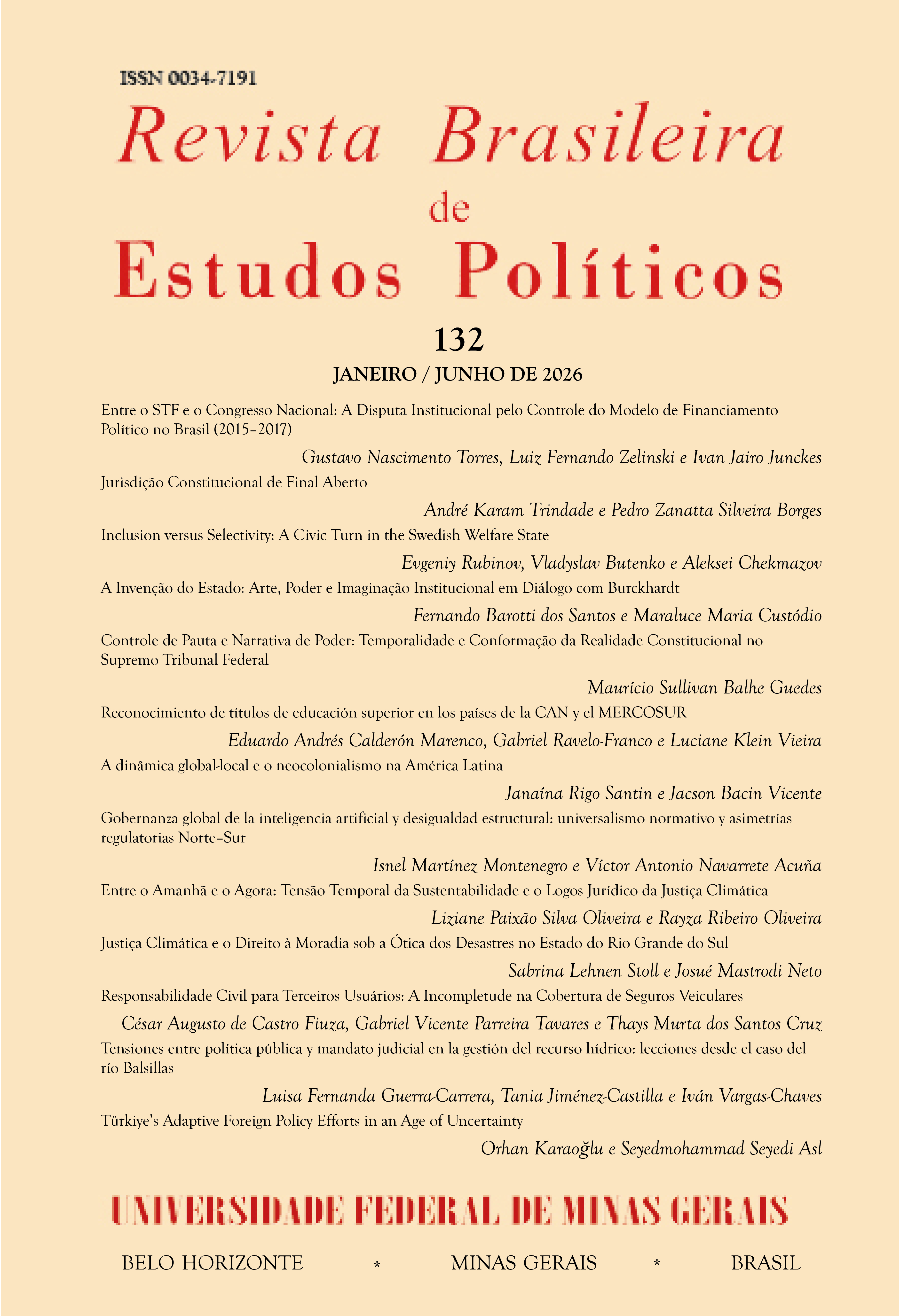
Türkiye’s Adaptive Foreign Policy Efforts in an Age of Uncertainty
DOI:
https://doi.org/10.9732/Resumen
Today, the world is proceeding within an atmosphere of both polycrisis and permacrisis. Geopolitical developments emerging at the global and regional levels are producing successive crises in political, social, and economic spheres. This situation necessitates intensive efforts by scholars in the social sciences—particularly experts in political science and international relations—to analyze and interpret these unfolding dynamics. The chain of global crises that began in the post-September 11 era has continued with the 2008 financial collapse, the Arab uprisings, the pandemic that affected the entire world in 2020, the Russia–Ukraine war that erupted in 2022, and the Israel–Hamas conflict in 2023. In addition to these developments, the global pressures and threats posed by climate change have further deepened the fragility of today’s world. Until the early 2000s, Türkiye’s strategic posture was considered to be oriented primarily toward strategic and economic ties with the West. However, beginning in 2005, the strategy of Turkish foreign policy was restructured according to new principles, including multidimensionality. Over the past two decades, the international system has evolved into a multipolar structure. Crises, regional conflicts, and new centers of power have emerged. States have sought to adapt to this transformation through various strategies. In the case of Türkiye, the prominent characteristics have been multidimensionality and flexibility. This study proposes a conceptual framework that can be used to analyze the recent period of Turkish foreign policy: Adaptive Foreign Policy. Adaptive foreign policy is defined as a state’s capacity to adapt to uncertainties, crises, and opportunities in the international system through dynamic, flexible, and pragmatic maneuvers.
Descargas
Publicado
Número
Sección
Licencia
Autores que publicam nesta revista concordam com os seguintes termos:
Os autores mantêm os direitos autorais e concedem à Revista Brasileira de Estudos Políticos o direito de primeira publicação, com o trabalho simultaneamente licenciado sob a Licença Creative Commons Attribution. Essa licença permite o compartilhamento do trabalho com reconhecimento da autoria e publicação inicial nesta revista, desde que sem fins comerciais.
É permitido ainda que outros distribuam, adaptem e criem a partir do seu trabalho, sem fins comerciais, desde que lhe atribuam o devido crédito pela criação original.
Autores têm autorização para assumir contratos adicionais separadamente, para distribuição não-exclusiva da versão do trabalho publicada nesta revista (ex.: publicar em repositório institucional ou como capítulo de livro), com reconhecimento de autoria e publicação inicial nesta revista.
Autores têm permissão e são estimulados a publicar e distribuir seu trabalho online após o processo editorial, já que isso pode gerar alterações produtivas, bem como aumentar o impacto e a citação do trabalho publicado.
Authors who publish in this journal agree to the following terms:
The authors maintain the copyright and grant the Brazilian Journal of Political Studies the right of first publication, with the work simultaneously licensed under the Creative Commons Attribution License. This license allows the sharing of the work with authorship recognition and initial publication in this journal, as long as it is not for commercial purposes.
It is also allowed that others distribute, adapt and create from their work, without commercial purposes, as long as they attribute due credit for the original creation.
Authors are allowed to enter into additional contracts separately for non-exclusive distribution of the version of the work published in this journal (e.g., publish in an institutional repository or as a book chapter), with authorship recognition and initial publication in this journal.
Authors are allowed and encouraged to publish and distribute their work online after the editorial process, as this can generate productive changes as well as increase the impact and citation of the published work.